
A Good Argument
- Bold Clear Premise (Thesis, Hypothesis)
- Step-by-Step Logical “Proof”
- Specific Details to emphasize and illustrate the reasoning
Does This Qualify as an Effective Proposal Argument?
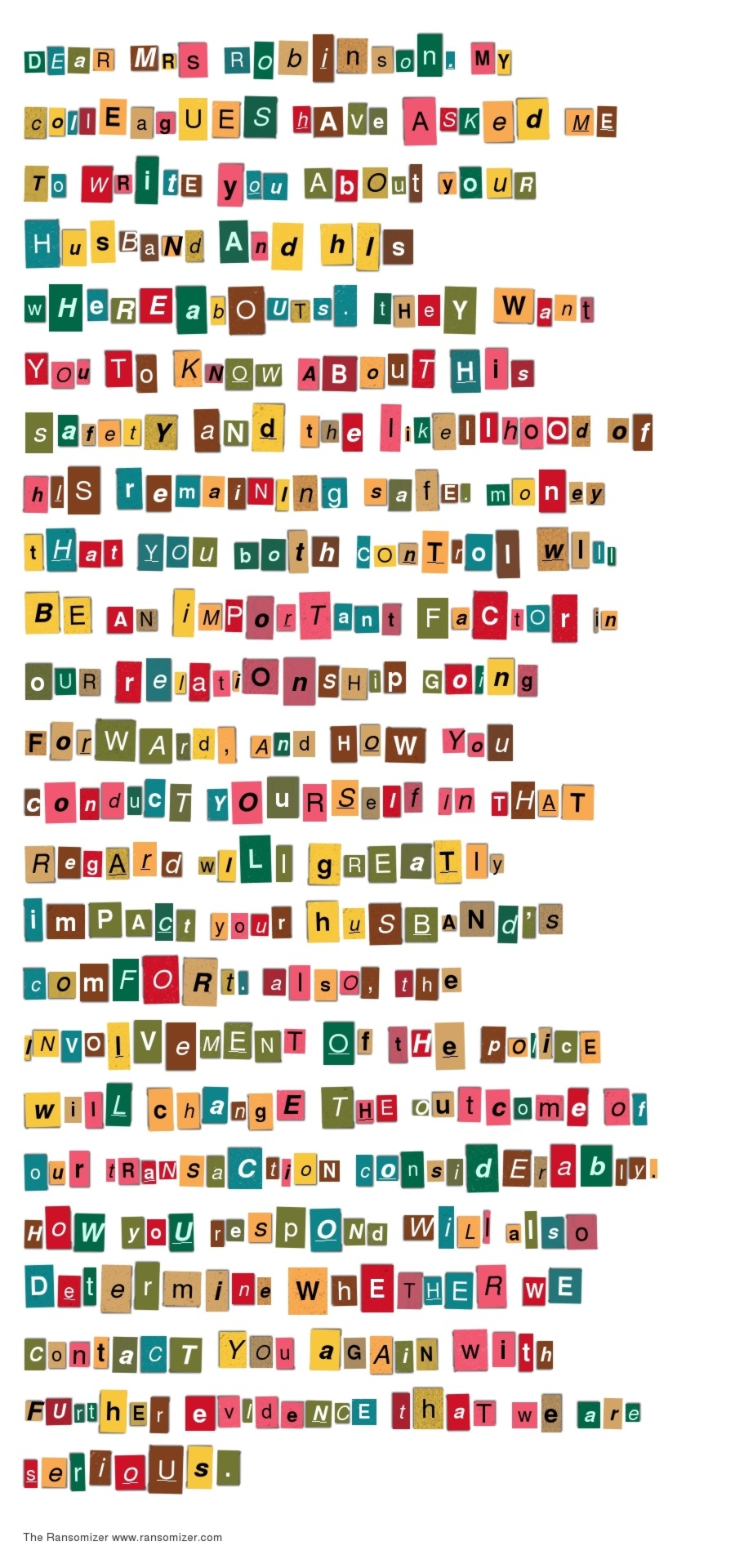
Yeah, that’s a horrible Ransom Note. And it would make a horrible argument of any sort. It has no clear premise, follows no logic, is so short on details it does not clearly communicate the consequences of following or failing to follow instructions.
Does this qualify?

This is more like it, a clear thesis (Proposal Argument: deliver money or lose your husband.), full of specific details and bold claims, it makes its purpose known and identifies the consequences for failure to follow its excellent advice.
Reply below how this comparison of two Ransom Notes helps you understand the value of very specific claims and illustrative language.


 Dev
Dev Joe Gramigna
 adamreim
 alexmoran17
 alivewit55
 americangods01
 anonymous123
 Anonymous
 azntaco
 belldere
 bigcounrty609
 bigfoot9
 bj112295
 blueee04
 breadpatrol99
 brxttyb
 calamariii
 cfalover
 charlieclover
 cherries267
 chickendinner
 chickennugget246
 chickennugget444
 clevelandbrown03
 cocochanel715
 comatosefox
 crossanlogan
 cswilliams15
 dancingueen
 disneylover2002
 doglover846
 dontquoteme187
 douglasadams525
 dt2018
 faded26
 friendoftacos
 frogs02
 fromcasablanca
 fulcrum66
 g00dsoup
 giants19
 gingerbreadman27
 girlno3
 gobirds115
 goodmusician440
 gracchusbabeuf
 hiralp365
 ifurreadingthisits2l8
 ilovedunkinoverstarbucks
 ilovenas
 imaspookyghost
 inspireangels
 JalenHurts4Mvp
 jasrielle2
 jcirrs
 jonnyb25
 eagles21
 kilotoon
 kingofcamp
 krackintheneck
 Philip Ebenezer
 Lily4Pres
 littlecow24
 ljkvng34
 lokiofasgard24
 luckyleprechaun1
 marinebio18
 Matt Loesche
 mellowtacos
 miliwawa
 minutemen14
 mossmacabre
 music0392
 mymomshouldhavenamedmegrace
 ndb1996
 neferpitou626
 nugget114
 oatmealvibes
 ohearnj8
 palal24
 peachesxo
 pinkheart84
 pinkmonkey32
 pitandthependulum22
 queenrandom04
 RowanAnnouncer
 Rowan27
 rowanluver29
 rowanstudent6
 saltysurfer322
 saycheese03
 Senpai Pio
 sixfortyfive645
 sortableelms
 spaghettitacosforthesoul
 strawberryfields4
 suedejackson
 sunflower0311
 sunshinegirl457
 tarheel1999
 teddysdoggydaddy
 thatwonguyy
 themildewmuncher7
 Public Display Name
 thirdlady226
 Thomas Laperriere
 tmjj4345
 toastedflatbread22
 tpaz1
tpaz1 tristanb50
 twofoursixohtwo
 tyblicky2001
 venom2929
 vicarij0
 wakeup5am
 Water
Water wildcuttlefish
 wizzard201
 xchuki
 Lunaduna
 zeek
zeek ziggy026
 zinny11
 zipemup1
 zoeyzoey0210
 zzbrd2822
 Counterintuitive Spring 2023
The second ransom note is much more descriptive with saying what they will do to her husband and give to her if they do not receive the ransom money. I would be much more likely to be persuaded by the second one as it is very detailed and it is specific enough that it does not seem like a joke.
LikeLike
The comparison of the two puts into perspective how important it is to be specific and to the point. If you’re not the reader has no shot at actually being engaged. Just as a ransom note isn’t persuasive, your writing will not capture your audience’s attention.
LikeLike
This proves the danger of being too wordy and vague-it loses the audience and doesn’t really get anything done. The good ransom note gets straight to the point and states what it needs, which is exactly what our paragraphs should do. We should write with a clear, direct language, just like a ransom note should.
LikeLike
From reading both notes, it is clear that using specific examples and very clear arguments will get you much further. You can’t beat around the bush when writing, and the second note definitely comes off as much more persuasive and clear. These have helped me understand the value of specific claims and illustrative language because of how much I was persuaded by the second note. The claims you use and the language you use could make or break your relationship with the reader, and they will be much more engaged if there are specifics.
LikeLike
The first ransom note fails completely to address itself, “what the person wants.”
The note is too vague and does not declare that the person has the valued item.
The second ransom note explains what the person wants, and says what they would do if you do not give them what they want.
In an essay, you need to be clear in what you are trying to say. The reader needs to fully understand the topic in the first paragraph.
LikeLike
The second ransom note was straightforward and precise enough to provide the reader a thorough picture of the situation.
LikeLike
The comparison of these two ransom notes helps me understand to be specific in my writing. Having an introduction argument that does not get a clear thesis and ideas across is not effective. Using specific language is important to get an argument across. Without specific claims and illustrative language the argument would not be effective and would not help your reader understand what your argument is.
LikeLike
The second ransom note adds more detail about how much money to give as a transaction to get her husband safety without involving the police, which could cause harm for the husband in the process than the first one, which say how much money or If the person has the husband at all as proof.
LikeLike
The comparison of the two ransom notes helped me understand the value of specific claims in illustrative language and in an argument. In the first ransom note, the writer making the argument chose “shallow” diction which worsened their argument- pacifying their point. In the second ransom note, the writer chose “bold” diction which aided their argument. The writer was clear in their argument and convincing with their reasoning.
LikeLike
The first ransom note is very broad. It does not describe in detail where her husband is, what they want in return for her husband back, or what to do with said money. The second ransom note right away goes into what is necessary to know; that they are holding her husband hostage and that they haven’t hurt him yet. They tell her how much money to withdraw (and even from which accounts) and where to place the money. Finally, they have proof that they in fact, do have her husband and put a threat at the end so she feels obligated to give them the money.
Comparing this to specific claims and language, it is extremely important that the reader knows what your claim is, and that you are not broad about describing it; they need to know every detail and they need to understand what you will be talking about in the remaining paragraphs. Not using this illustrative and descriptive language will result in your reader being confused; they should be able to easily visualize your argument.
LikeLike
When comparing the two notes it becomes clear what the people want from you in the second note. Whereas, in the first one they never really specify what they want exactly or how you should continue with the matter at hand. Also in the second note there was a very real threat if you should not comply with their demands.
LikeLike
The comparison of the two Ransom notes helps me understand the value of very specific claims and illustrative language by differentiating between a bold, clear claim and a weak claim. The first ransom note did not have specific details and made it harder to follow or understand. The second one provided proper details and identifies the consequences for failure to follow the instructions.
LikeLike
In the first ransom note the true intentions of the black mailer are vague. While it is clear to see in the second ransom note, the writer expresses that they want large sums of money and no police involvement in return for the husband’s safety. Although it would be more convincing if the ransom note was more reckless then gramatical, I understand how it relates to our writing assignments.
LikeLike
The second ransom note is more specific and has a more threatening tone to the note, meanwhile the first ransom note was not threatening and was wordy. Ransom note two, had specifics like sending the husbands wedding band to prove they have him, how much money to take from the bank, where to put the money, when the money should be placed, and if the money wasn’t there they would send the husbands ring finger. Note one, was basically saying that the safety of the captured isn’t safe but were being specific of what they want in return.
LikeLike
The first ransom note has a lot of gaps. It requires a second note and if you’re holding someone hostage and as a ransom note seems like a bad choice. There’s no detail of the amount of money they want, where to put it, and doesn’t apply enough pressure to deliver the money. The second note covers all the points you need without requiring a second letter for information.
LikeLike
The first ransom note was very unclear and does not qualify as an argument. The second ransom note is more to the point and a lot more clear. There is not enough detail in the first one and many mistakes could be made such as how much money and where the money should go. But the second ransom is making it well known about how much money, the proof they have of the husband being with them, and where the money should go to. The second ransom note is more convincing.
LikeLike
This analogy shows how important it is to include details when writing. You need to present the main ideas, be specific, and use logic in order to get your ideas across in the most effective way. Without this, it is just a collection of words that has no real meaning or effect on the reader.
LikeLike
The second ransom note goes into more detail and specifics about the situation and gives whoever is reading it clarity as to what to expect and what to do. The first isn’t as threatening and does not make as much of an impact. All of the information is given in the first note and says all of the ‘right’ things. This relates to writing assignments because it shows that we need to be clear and concise with out writing so that the reader does not have to think twice about things and completely understands the intention of each word.
LikeLike
the first ransom note is far to vague with the details, and would take a considerable amount of brain power to understand that it was actually a ransom note. It lacks logic, premise, proof, and outcome. The second note however gets to the point that it is indeed a ransom note. It provides thorough details about what has to happen and what will happen if the ransom is not paid.
LikeLike
The comparison between the two notes leaves a better understanding on what is required in a good argument. There needs to be some sort of conviction, alongside detailed word choice that applies to the situation. While the first note is very broad and can be determined in numerous ways, the second note does not leave that opportunity.
LikeLike
The first one didn’t give a clear goal, it seems fake. The second gives proof, a goal, and consequences if the goals are not met, or the police get involved. It states everything in a timely manner in order to get their point across quickly and clearly. You would not need a follow up from them, they gave you what you need in order to make a decision.
LikeLike
The second note is much more effective because it includes specific details, and it is much more threatening. The first note is too vague, and not specific enough for the reader to totally understand. Seeing the comparison of these two notes, I’ve learned that I must be more specific in my writing.
LikeLike
Being descriptive and precise in your argument is an important way to make it convincing to the reader. The first letter was vague and unconvincing, leading it to be confusing and possibly misinterpreted. Our arguments should be more like the second letter as it was more convincing due to its more precise language and more descriptive arguments.
LikeLike
While the first ransom note is extremely vague and is not very convincing, the second note makes the intentions of the ransom holder much more clear. This example illustrates the importance of including details to build credibility. It makes the reader take your claims much more seriously. Furthermore, it asserts that you are sincere and your arguments are worth consideration.
LikeLike
The first ransom note did not even give the recipient any reason to believe what they are saying. There was no clear argument and no where did it say that they were “holding the husband for ransom.” The second ransom note was very clear and other than the fact that the recipient didn’t know if she’d get her husband back even if she paid, the rest seemed convincing. They gave the wedding band as proof that they had him, and they used scare tactics by stating the consequences if she didn’t follow what they said.
LikeLike
The first ransom note is too unclear and there were not good enough supporting details to support the claim. It does not really prove any point or help the reader understand. The second note is clear and gets right to the point making it an actual ransom note.
LikeLike
The intentions of the kidnappers is more clearly stated in the second note.
They state what is needed to be done by the notes recipient, they make threats and continue to say that a repercussion of non compliance will result in further detriment to they women’s husband.
LikeLike
The first ransom note had me confused and caused me to misread the paragraph. I was confused on the purpose of the note. I figured it was just informing me on something. But, when I read the next note, I understood the message and the details were specific. Clear message.
LikeLike
The difference between the first and second ransom note clearly illustrates how important it is to avoid wasting words or being overly vague. If you don’t specify details and take too long to get to the point, you risk losing the reader’s attention.
LikeLike
The second ransom note, in comparison to the first, is much more specific. It clearly illustrates the motives and wants of the kidnappers and gives Mrs. Robinson a clear argument to follow. The first argument is too wordy and vague, and would most likely be taken as a joke due to the fact that it is hard to follow.
LikeLike
Would it surprise you to know that the Ransom Notes contain the same number of words, PitAndThePendulum?
Number of words is crucial, but not by count. Eliminating USELESS words is the key.
LikeLike
The first ransom note compared to the second ransom note was not as clear and bold. The second made bold claims and you could actually follow what the note was saying. For the first one, I had to go back and reread some parts. Specific details in the second ransom note make it easier to understand what the kidnappers are actually asking for.
LikeLiked by 1 person
Mrs Robinson is still trying to figure out the first one.
LikeLike
The first ransom note warns me not to be vague with my arguments. The updated ransom note is bold and to the point. If you don’t specify details or illustrate your point clearly, your argument is a lot less feasible.
LikeLike
Uh-huh!
You’ve been told this before, surely, but have you ever seen it illustrated so convincingly?
LikeLike
The difference between the first ransom note compared to the second is the inclusion of specific details. With out the bold claims the second ransom note made, you have no idea what the person wants you to do or what they are doing. When reading the second note you fully understand what you need to do and what they will do if you don’t follow instructions sufficiently and quickly, Unlike the first note. The first note gave us a whole lot of nothing with no claim.
LikeLike
Which one makes a good Persuasive Argument?
LikeLike
The second was definitely way more descriptive than the first one. The first one just made you wonder and made you very confused. The second one also really captured my attention quickly, especially with the very first sentence when they said that they abducted the husband. It is important to get to the point so that you can capture the reader.
LikeLiked by 1 person
Just right.
LikeLike
The second ransom note includes way more details and information regarding to what the people holding the husband want. They make it clear what exactly they want and instructions on where to drop off the money. They also make it clear what they will do to the husband if the demands are not met. The first ransom note is not clear at all and lacks important details and information that makes it a true ransom note.
LikeLike
Yeah
LikeLike
The difference between effectiveness in both ransom notes goes to show just how far getting straight to the point and providing details will take you. Sometimes you just need to cut to the chase. What made the second ransom note significantly better was the fact that it provides you with a lot more detail, while also still not providing you with too much detail.
LikeLike
Good about “cutting to the chase.”
LikeLike
The lesson I believe is most beneficial from this exercise is to choose your words carefully. To know what tone you want to communicate and how many words you need to get there. Adding too many words loses the intended message entirely and you should steer clear of doing so.
LikeLike
Interesting. I thought this was about clarity and directness, not brevity.
LikeLike
The two ransom notes effectively demonstrate the difference between strongly-worded, specific claims and vague statements. Assuming the two notes were written with the same intention, it is unclear if the first one is actually threatening. Vague appeals to how involving the police will change the outcome and the like do not make clear that the sender doesn’t want the recipient to contact the police. In contrast, the second notes outlines clear consequences for non-compliance and makes (presumably) actionable threats agains the recipient of the note and her husband.
LikeLike
Presumably THIS!
LikeLike
The first and second ransom note differ because the first note was very vague and did not really say the information that they were trying to express to whomever the letter was written to. The second note on the other hand was very straightforward and much easier to understand. This made me come to the conclusion that we should take this advice and carry it with us when writing our argumentative essay. When something is too wordy and does not directly get to the point, it can be confusing and overall, not useful.
LikeLike
I’m almost always willing to see the value in brevity, and I like the brevity of the second example here, too, RL. But the primary lesson here is the directness, the clarity, the extreme bluntness, if you will, of the claims that makes them so much more effective in the second example.
LikeLike
In the first ransom note, it wasn’t as strong as the second one was, the fire wasn’t there and it was more of an email rather than a threat. The second ransom letter demanded strict instructions and follow-ups as to what would happen if the person were not to comply. You need to be straightforward and have an attention grabber so the person reading it could understand the tone you’re trying to give off. If the first ransom note had been sent it would have been nothing but a joke of a threat.
LikeLike
I love “the fire wasn’t there.”
Let the fire always be there, Water.
LikeLike
There is a clear difference between the two ransom notes, The first note was very vague about what they would do if they did not receive the payment and they were even vague about what kind of payment they even wanted. They seem to beat around the bush so it was very hard to understand and didn’t sound very serious at all. The second ransom note was much more clear and more straightforward with what they wanted and what they would do. This shows that we should be making our arguments very clear and straight to the point rather than making our arguments sound redundant or not serious. By beating around the bush you lose the reader’s attention and interest in your argument.
LikeLike
You kept my interest throughout, SayCheese.
LikeLike
The first note heavily relies on implications, and doesn’t clearly state anything. The second note is much more direct, stating the specific amount of money desired and clearly warning the author will cut off her husbands finger should she fail to comply.
LikeLiked by 1 person
Which one’s better? 😉
LikeLike
This shows that you shouldn’t drag out what you’re trying to make a point of because the audience could get bored easily, what should be used first is something to grab the audiences attention and drag them in, get your point across. The second one illustrates the correct way this should be done, as the first one illustrates the incorrect way that will have you lose a readers attention quickly.
LikeLike
Would it surprise you to know that the Ransom Notes contain the same number of words, Blueeeeeeeeee?
Number of words is crucial, but not by count. Eliminating USELESS words is the key.
LikeLike
The first ransom note is too wordy, and most likely lost the reader’s attention since they didn’t specify the leverage they have or what they want from the reader.
The second ransom note is more specific and straight to the point, making it more threatening. This shows us that specifying the details will retain reader attention.
LikeLike
Oddly, the two notes have the same number of words. What makes the first version sound “wordy” is not the number of words but the lack of claims.
WORDS USED WITHOUT MAKING CLAIMS ARE WORDY.
LikeLike
The first argument is indirect, basing the argument off of vague threats. The second argument is much more clear, stating the exact amount of money desired and what will happen to Mr. Robinson should Mrs. Robinson fail to comply.
LikeLike
I’m guessing she paid.
LikeLike
The first ransom note is very vague and has no claim. The updated ransom note is bold and to the point. The second note is very specific and has a great argument, it allows you to understand what needs to be done and what they will do if you don’t follow do as they say.
LikeLike
That’s the difference, all right.
LikeLike
The two ransom notes showed how one can be ineffective whereas the other is effective. To make something effective you have to make your argument or claims very clear and bold so the person reading it does not question what they are being told or asked to do. Details are also important because they help specify what you are saying.
LikeLike
It might sound comical, but treat your readers as if you were holding their loved one’s hostage.
LikeLike
The first note is too general and makes it confusing on what they are asking for. The second is descriptive and is clear in what they want and how they want it done.
LikeLike
The first ransom note was “too wordy.” There was no clear premise of what the abductors intended to do. It was almost as if they tried to be threatening, but failed.
The second note had a very clear premise. They stated specific instructions to be followed by Mrs. Robinson and had clearly stated what would happen if she did not do what she was told.
LikeLike
That’s the difference, all right!
🙂
LikeLike
Ransom note 1
Horrible random note
Doesn’t clearly communicate any instruction or consequences
Ransom note 2
States what she wants her to do and the consequences if she doesn’t
however doesn’t say why they are doing this however there might be no reason as to why just that they need money.
LikeLike
Think if she knew more about them she could talk the kidnappers into releasing Mister Robinson? 🙂
LikeLike