My Counterintuitive Weekend
Before you can write counterintuitive arguments, you’ll need to understand counterintuitivity as a concept, but I think that rather than offer you a definition of the term, I can serve you better with some illustrations. The broader and more diverse the examples are, the better I think you’ll understand the scope of counterintuitivity. Let’s just say to begin that things are not what they seem, and that common knowledge is usually wrong.
Unanswerable Questions
For example, at some point in my Catholic grade school education, I started to wonder if maybe God was made in man’s image instead of the other way around. That insight is common to young Catholics who are exposed to deities of other cultures and quickly conclude that they can’t all be accurate, and that which one we believe has more to do with where we were born than anything else.
Maybe because we can’t comprehend eternity, we call eternity God. And because we can’t comprehend infinite space without bounds, we call the limitless universe God. We can’t accept the lack of justice on earth, so we imagine heaven where the scales are all balanced. If so, God doesn’t actually resolve the incomprehensibility of anything; deity is just a way to phrase our unanswerable questions.
Embracing Uncertainty
What we believe to be the case is probably not. Call this a scientific way of thinking. Every conclusion, as soon as it’s proven, is subject to fresh dispute. That may sound like despair, or it can sound like progress. In this class, if we begin to think we’ve resolved a question once and for all, we’ll be surrendering before the ultimate revelation that we’re never done dismissing old, bad ideas, including the best we’ve had so far.
Running errands a few weeks ago, often with the radio on in the background, I had some counterintuitive thoughts.
-
Facebook has more gender categories than the Olympics
Have you heard about this? Instead of forcing users to identify as merely male or female, Facebook has introduced a third massive category of “custom” gender options including “transgender,” “cisgender,” “gender fluid,” “intersex,” and “neither.”
I don’t know whether this will solve or further complicate a problem social media has always had of not knowing what to call us when they recommend us to others. You’ve probably noticed oddities such as, “David Hodges would like you to view their page.” Maybe now that I can choose my gender more specifically, they won’t be so squeamish about calling me “he.” But if I choose “neither,” will they say, “David Hodges would like you to view its page”? Time will tell.
I heard this news while thinking about Olympic athletes from now and ages ago whose genders created questions or disputes. Chinese gymnasts of earlier games are thought to have been as young as 12 or 13 (girls, not women; not exactly a gender problem, but a category problem). Also loudly whispered was the question: were the 14- and 15-year-old competitors fed hormones to delay their advancing development from girlhood to womanhood?
On the other extreme, were Russian athletes in strength competitions actually genetic gentlemen competing against the ladies, or again steroid-fed women whose physiques were artificially masculine?
Now finally, there are some women competing in bobsled contests, but still the gender divide is fairly complete: Men’s Downhill, and Women’s Downhill. How long can these binary categories last when in the rest of our lives we’re invited to be more selective in which gender we “present” to the world?
My Shopping List is an Argument
If I don’t tell you in the first ten minutes of class, I will certainly tell you soon after, that every written document is an argument. In “every written document” I include news reports, weather forecasts, histories, biographies, autobiographies, technical manuals, lab results, baseball statistics, recipes, and road signs.
I challenge students with this premise all the time because it sounds so implausible, but I’d like to present a shopping list as an example of what I believe to be a written argument, written for a particular audience, which becomes a battleground for dispute in the hands of any other reader.

Argument Depends on Audience
As long as I (the intended audience) have this list with me, my reader (me!) is unlikely to argue with its premises. But even so, I may decide to substitute Hagen-Dasz for Breyers if the price is right. But if my wife takes the list to the store on my behalf she may present compelling counterarguments to my “conclusions” on the following grounds or others:
Counterarguments
- Who needs premium ice cream?
- Will he ever notice the difference between conventional kale and organic kale (Is there actually a difference?)?
- We already have plenty of drawstring bags.
- We don’t have room for 24 more seltzer bottles.
- Since when do we buy beef specifically for the dogs?
- Even if the per-pill price is significantly cheaper, I can’t believe we’ll use 1000 ibuprofen before their effectiveness expires.
Diarists Lie
On this topic, please remind me to argue that a diary is written for a very specific audience and therefore is as manipulative and artificial as any other piece of writing. (If you need a preview of this demonstration I will direct you to Francine Prose’s wonderful examination of Anne Frank’s Diary of a Young Girl, which, she argues convincingly, was extensively edited by Frank for the sake of future readers.) She calls the book “a masterpiece written by a complicated artist who died too young.”
The only known video of Anne Frank.
Quiz Question: who is the very specific intended audience for your diary?
Quiz Question: who was the intended audience for Anne Frank’s Diary?
Mitt’s Audience
On this topic also, I could share with you the video captured at Mitt Romney’s campaign fundraiser during the run-up to the 2012 presidential election. If you can imagine him making the same speech to any other audience, then you haven’t started thinking seriously about how exactly we craft what we write to suit our intended readers.
Link to the speech.
Duchamp’s Readymades
Marcel Duchamp is a favorite of mine, and I’d recently been to the Philadelphia Museum of Art, so when I found myself handling paring knives and graters in the kitchen, I asked myself the simple question: is this item art?

It’s certainly beautifully designed and crafted, but my instinct tells me that its functionality prevents it from being art. It can be artful, but not art. My working definition is that art is something created for no other purpose than to be observed or experienced. Still, I’m disputatious by nature, so I didn’t let that first impression stop me. It certainly didn’t stop Duchamp from calling this art:

He didn’t create it, design it, weld it, or change it in any way except to sign it and remove it from the place where it would have had a function. Placing it into an art gallery, for Duchamp, and for the rest of the art world, effectively transformed a wire bottle rack into a piece of art. So maybe my definition still works. Maybe not.
If you think this one bottle rack is art while the thousand others in the factory are not, and that swapping one for the other would transform the one in the gallery into art while transforming the other back into a functional object, then you’re beginning to grapple with counterintuitivity. As you do so, you’ll stop taking things for granted. And stop thinking that anything is obvious.
Tim’s Vermeer
While I was puzzling over readymades and washing dishes, I was reminded that I hadn’t yet seen a documentary that had been on my list.
The Dutch painter Vermeer is well-known for his remarkably realistic interiors in which people and furniture are carefully arranged. He handled perspective perfectly, long before other painters had a clue how to realistically portray actual items in space.

Inventor Tim Jenison thought he might have an idea how Vermeer accomplished his remarkable achievement. He knew, as many did, that pinhole cameras had been used by artists for years to project images onto walls for reproduction.
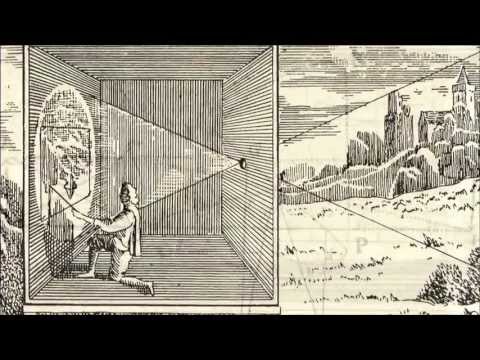
Jenison is an inventor, not a painter, so he wondered more about how such a “machine” might help him accomplish a job than about whether the result would be art. This early question eventually led him to discover that he too could accomplish remarkably “artistic” results through mostly mechanical means. First, he built a room like the room in Vermeer’s “Music Lesson.” (Vermeer skipped this step because, for him, the room existed in his neighborhood.)

Then, he dressed models in appropriate clothing.

Then, using mirrors to reflect images of the room just in front of his canvas, he mixed paints to match what he saw before him, and, without any artistic training, he produced facsimiles of the images he placed before the mirrors.
Link to the video
After years of practice, trial, error, and corrections, he has upset a lot of people by painting this:

The first counterintuitive claim that can be argued here is that Vermeer painted “by eye,” without relying on the mechanical process Jenison employed. We only think it’s “obvious” that he did so because of what we think we know about the art of his time.
We might also claim that Jenison is (or is not) an artist, based on different definitions. He does not profess to have “artistic talent,” but he did produce a Vermeer, by hand, with paint and brushes. We don’t dispute that Vermeer is an artist, but what if he used a similar technique?
One More About Art
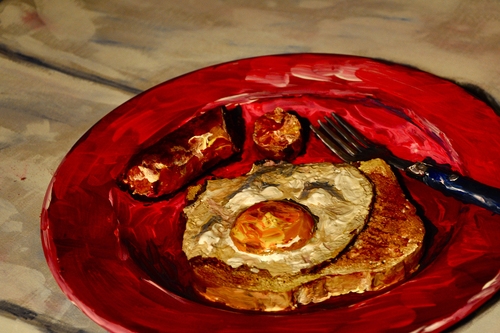
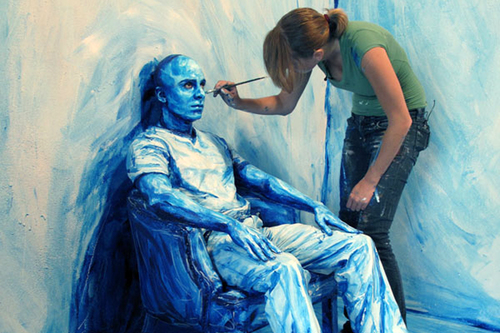
Alexa Meade has a different way of representing three-dimensional objects as two-dimensional objects. She paints directly on the objects, turning them from objects into paintings.
This isn’t a painting of breakfast. It’s breakfast, painted. It’s an actual egg, on toast, on a plate, by a sausage, with a fork, on a plate, the surfaces of all of which have been painted to resemble a representation of the objects they are.
And this is not a painting of a man on a bus. It’s a man on a bus, painted.

Here’s how it looks when she’s working on it.
Here’s how it looks when other people look at it:

Let’s apply a different way of thinking to some real-life social and ethical issues.
Bariatric Surgery
Do you have a strong feeling about bariatric surgery? I don’t. I’m sympathetic toward people who can’t seem to keep their weight under control despite their best efforts. I’ve conducted enough skirmishes with my own body to appreciate that our appetites are not merely hungers we can control with “will power.”
I also don’t think “will power” is a commodity we all have access to in the same supply. So a person whose body conspires to withhold every calorie, who also lacks the psychological ability to deny himself, or the physiological signal that tells the rest of us we’re “full,” is just cursed and needs some help.
So, why does this story from the Wall Street Journal disturb me so much?
“As the World’s Kids Get Fatter, Doctors Turn to the Knife.”

Daifailluh al-Bugami, 3 years old, is awaiting bariatric surgery. Daifailluh is among a rapidly growing number of kids in Saudi Arabia undergoing radical surgery to control their weight. In the last seven years, Daifailluh’s doctor has performed bariatric surgery on nearly 100 children under the age of 14 from countries in the Gulf region.
Euthanasia for Kids
This one you’ll find linked to the blogroll of our class blog. From the New York Times: “Belgian lawmakers gave final approval on Thursday to a measure that would allow euthanasia for incurably ill children enduring insufferable pain. King Philippe is expected to sign the measure into law and make Belgium the first country to lift all age restrictions on legal, medically induced deaths.
“Under the measure, approved 86 to 44 by the lower house, euthanasia would be permissible for terminally ill children who are close to death, experiencing ‘constant and unbearable suffering’ and can show a ‘capacity of discernment,’ meaning they can demonstrate they understand the consequences of such a choice.”
As you can imagine, despite the majority in the legislature, the prospect of letting kids decide to die, and helping them do so, has some very vehement opponents.
Why do I consider this question counterintuitive?
There are more than two points of view here.
- Some might object to assisted suicide period.
- Others might insist we all have the right to end our lives if they’ve grown intolerable.
- Those in the middle might think it’s acceptable for the very elderly to end their lives slightly prematurely but be appalled at the prospect of ending a child’s life.
- All three points of view are counterintuitive.
What’s counterintuitive about them?
- We can’t actively promote killing ourselves without feeling the natural resistance of our bodies to preserve themselves. (It seems obvious that we shouldn’t kill ourselves and therefore counterintuitive to argue that we should.)
- We can’t logically insist that our loved ones continue to suffer after they’ve concluded that their lives are worth more to us than to themselves and very little to either.
- And if we want to claim that the elderly have a right that is somehow unavailable to youth, let me suggest this:
- Distance from birth is one way to calculate age; distance from death is another.
- By the second calculation, the child with the terminal illness is older than you and me.
If you want to change the world . . .
change the metaphors we use to describe it.
Here is a sleeping dog. Everything we have experienced of dogs tells us that this is clearly a dog and that no rational argument could be made, based on the photograph alone, that the dog is anything other than resting, most likely asleep, and probably unaware of our presence.
We are so accustomed to seeing sleeping dogs that we don’t experience them anymore. And since we have little to fear from domesticated dogs, we don’t react as their prey might react during a chance encounter with one.

But add just two little black dots, and here is what the dog’s predators and prey might see when considering whether to attack or flee the “sleeping dog.”

Those light patches of fur were clearly favored by evolution because they helped the dog survive. As humans who do not fear the dog, we have learned to ignore them. We see them as mere “colorations” or “markings” of the rottweiler. How many other things have we learned to ignore? How many other signals do we miss when we take for granted that our “common knowledge” is knowledge?





 Dev
Dev Joe Gramigna
 adamreim
 alexmoran17
 alivewit55
 americangods01
 anonymous123
 Anonymous
 azntaco
 belldere
 bigcounrty609
 bigfoot9
 bj112295
 blueee04
 breadpatrol99
 brxttyb
 calamariii
 cfalover
 charlieclover
 cherries267
 chickendinner
 chickennugget246
 chickennugget444
 clevelandbrown03
 cocochanel715
 comatosefox
 crossanlogan
 cswilliams15
 dancingueen
 disneylover2002
 doglover846
 dontquoteme187
 douglasadams525
 dt2018
 faded26
 friendoftacos
 frogs02
 fromcasablanca
 fulcrum66
 g00dsoup
 giants19
 gingerbreadman27
 girlno3
 gobirds115
 goodmusician440
 gracchusbabeuf
 hiralp365
 ifurreadingthisits2l8
 ilovedunkinoverstarbucks
 ilovenas
 imaspookyghost
 inspireangels
 JalenHurts4Mvp
 jasrielle2
 jcirrs
 jonnyb25
 eagles21
 kilotoon
 kingofcamp
 krackintheneck
 Philip Ebenezer
 Lily4Pres
 littlecow24
 ljkvng34
 lokiofasgard24
 luckyleprechaun1
 marinebio18
 Matt Loesche
 mellowtacos
 miliwawa
 minutemen14
 mossmacabre
 music0392
 mymomshouldhavenamedmegrace
 ndb1996
 neferpitou626
 nugget114
 oatmealvibes
 ohearnj8
 palal24
 peachesxo
 pinkheart84
 pinkmonkey32
 pitandthependulum22
 queenrandom04
 RowanAnnouncer
 Rowan27
 rowanluver29
 rowanstudent6
 saltysurfer322
 saycheese03
 Senpai Pio
 sixfortyfive645
 sortableelms
 spaghettitacosforthesoul
 strawberryfields4
 suedejackson
 sunflower0311
 sunshinegirl457
 tarheel1999
 teddysdoggydaddy
 thatwonguyy
 themildewmuncher7
 Public Display Name
 thirdlady226
 Thomas Laperriere
 tmjj4345
 toastedflatbread22
 tpaz1
tpaz1 tristanb50
 twofoursixohtwo
 tyblicky2001
 venom2929
 vicarij0
 wakeup5am
 Water
Water wildcuttlefish
 wizzard201
 xchuki
 Lunaduna
 zeek
zeek ziggy026
 zinny11
 zipemup1
 zoeyzoey0210
 zzbrd2822
 Counterintuitive Spring 2023