Stone Money- bigfoot9

It is rather eerie to know that the money that sits in people’s bank accounts is not really there. That the number projected on a mobile screen or an ATM machine will indicate how much money is in a certain account, but it is not just is not sitting there waiting for someone to come along and pick it up. A lecture was once taught to me and before I even knew that it was about the abstract value of money, I understood that the piece of paper just promises a person a certain amount of money, but that was not always the case in any society.

On the Island of Yap the inhabitants had their own way of currency. They would cross over 400 miles of rough waters to mine their Fei. Fei, according to the essay The Island of Stone Money by Milton Friedman, were these large circular lime stones that had a hole going through them so that the miners would easily stick a rod through the hole in order to transport it onto the boat. These Fei could always range in size depending on the amount of the wealth the person had. On a NPR broadcast, the broadcasters called the Fei a “Financial Innovation”. If they were large enough, the Fei would remain in one area and if the title ship of the owner changed for any reason such as but not limited to, a dowry, to build something, or if a battle was lost. Everyone in town knew which stone belonged to which islander and understood how much wealth they had. There once was a ship that crossed the river and on its way back with the biggest Fei anyone would ever see, the boat faced a storm and cut the rope that the Fei was on. When they got back they described the Fei to everyone in town so that everyone knew how much wealth this one islander had and if he needed to get anything that owner ship of the sunken Fei would transfer.

Now times have changed since Fei and while the value still holds, the size is different with this currency. The new type is titled Bitcoin. According to Bobby lee in an article titled Bitcoin: What to Expect in 2015, that “it has a small circulation value now, but theoretically, with wide adaption, the circulation value should be 100x or 1,000x what it is today”. That would mean that Bitcoin is here to stay and may take over the standard dollar in my view. It was backed by  100 million dollars so faith must be in the system for it start taking over.In another article Bitcoin has no place in your- or any- portfolio, the author flat out states that “Bitcoin should not be on your radar” The author says that the idea has lost profit over the years and is not worth anyone’s attention.

So after learning about the Yap and more on the Bitcoin, I think it is safe to say that even through the lecture I haven’t changed my views on the abstract idea of money. I have faith that the money I put in the bank is always there and backed up when I need it and the stock market will not have a crash like before.

Works Cited

Friedman, Milton. “The Island of Stone Money.” Diss. Hoover Institution, Stanford University, 1991.

“The Invention of Money | This American Life.” This American Life. N.p., 7 Jan. 2011. Web. 06 Sept. 2015.

Phillips, John. “Bitcoin: What to Expect in 2015.” CNBC. N.p., 15 Dec. 2014. Web. 07 Sept. 2015.

Reeves, Jeff. “Bitcoin Has No Place in Your – or Any – Portfolio.”MarketWatch. CNBC, 31 Jan. 2015. Web. 6 Sept. 2015.

Posted in Stone Money Links | 2 Comments

Stone Money- peachesxo

The concept that money does not exist is mind-boggling. In the American society, money is no longer a physical object. Money is handled through the computer more often than it is handled physically; yet, there are still some places that do not use computers to handle money. The island of Yap is a prime example of physical money. The islanders of Yap have a unique currency system that is beyond strange to me. They use  lime stone to create these massive coins called fei.  The bigger the fei, the more wealthy a person is; however, some of these stones are too heavy to move. Because it is so heavy to move the fei will usually remain in one place. When the owner of the stone changes, people will know that there is a new owner.  The islanders of Yap traveled 250 miles off shore to find these lime stones to create the fei. One man had several workers go off to make a big fei; however, when the workers sailed back, there was a storm. The stone ended up in the bottom of the sea. The workers came back and told everyone about the stone. At the end, the stone’s value was still recognized.  This type of currency may seem absurd, but it is no logically different from ours. Back then, our currency used to be gold (which was always held in a bank). If you wanted to pay for something, you would get a piece of paper stating the amount of gold that is getting paid. The idea of money is no abstract. We never see the money get deposited or moved. For example, in the NPR broadcast “The Invention of Money”, a member of the Planet Money brought up a good idea to further inspect. When you get a job, your boss does not hand you the money, instead it is directly deposited. You cannot see the money; all a person does is wait for the numbers to change on their bank account statement. Money is just an idea that we all believe in. Anyone can change the value of currency and we would still believe in it.  In the end, money is something so abstract. We are the ones that put the initial value on money (in Yap, stones).

The NPR broadcast “The lie that Saved Brazil”, is about the inflation that happened in Brazil. The price of goods would rise every week in Brazil, this is the product of the new city Brasilia. This is a city that was built in 1950. Then the government of Brazil started to print print a massive amount of money. Now, Brazilian money started to lose it’s value. When people got paid, they would spend it right away before it loses it’s value. Some people would hide cattle so the meats could stay a good price and not go down. In March 27, 1993, the government sought out four friends who had an idea on how to stop inflation. They wanted to restore the faith people had in money. These four friends developed a currency called Unit of Real Value a.k.a URV. One URV would be equivalent to 7 cruzeros one week and the next week one URV might be equal to 10 cruzeros. The URV is a form of virtual currency that everyone started to use. The government saw the progress of Brazil and decided that the URVs will be the new form of currency. While listening to this broadcast, I realized that our form of currency can be altered.

We might think of electronic currency to be absurd; yet, in the American economy there is a currency called Bitcoin. Bitcoin was assimilated into society about a year ago. Bitcoin has no true value; but, people still believe in it like the URVs in Brazil. People get tricked into thinking currency is already at a valued price. Bitcoin will cause a network affect.  Everything is done electronically so this creates a chance for bitcoin to succeed.   If other people use the currency bitcoin, that means other people will use it as well. People will trick themselves into thinking that bitcoin is a real currency. This is the same situation in Brazil without  inflation.

Going back into our economy, money is handled through the Federal Reserve. They can create money whenever they want and they can control the amount of money the economy gets. The real question is where does this money all come from?  Did the money just come from some void? The federal reserve decided to print more money. They would give banks millions of dollars by buying treasury bonds. I found out that the Federal Reserve would press a single button and that will change how much the bank would get. It’s scary how the government can manipulate and make money. How do we know if someone is wealthy? We can never see the money, but we believe in the numbers that are presented to us on a single piece of paper.

Money has a set value because we perceived them that way. What makes money different from each other? They are all a piece of paper that have been printed from the computer. In Yap, the stones are an odd concept to uphold; however, we had gold which had a similar concept to the fei. In Brazil’s currency  changed because the government decided to. That’s happening now in America because of Bitcoin. The creators of bitcoin are hoping people can influence each other to use this new currency. Money is not a physical object anymore, it’s just a statement on the computer. Money is just an idea that we believe in. People set forth how much a dollar bill is worth and how much a hundred dollar bill is worth. Can they be the same though? Money is just a piece of paper that can be manipulated and we would be okay with it.

Works Cited 

Friedman, Milton. “The Island of Stone Money.” Diss. Hoover Institution, Stanford University , 1991.

Joffe-Walt, Chana. “How Fake Money Saved Brazil.” Npr.org. NPR, 4 Oct. 2010. Web. 6 Sept. 2015

Phillips, John. “Bitcoin: What to Expect in 2015.” CNBC. N.p., 15 Dec. 2014. Web. 04 Sept. 2015.

Reeves, Jeff. “Bitcoin Has No Place in Your- or Any-portfolio.” Market Watch. N.p., 31 Jan. 2015. Web. 4 Sept. 2015.

“The Invention of Money | This American Life.” This American Life. N.p., 7 Jan. 2011. Web. 04 Sept. 2015.

Posted in Stone Money Links | Leave a comment

Stone Money- brxttyb

On the small island of Yap located in Micronesia, large limestone disks the size of cars are what they use for their currency. Sounds weird, don’t y0u think? Ironically though, the most illogical form of currency is a bit more close to home. “Fake Money”, actually saved an entire country that is now rumored to be the next super power. What is the abstract concept of this thing that makes the world go round?

In the Caroline Islands, there is a small island that goes by the name of Yap. The natives, use a currency of “fei.” Fei are large limestone disks the size of cars. The Yap people mined them and carried them back on bamboo stretchers. Fei was not just for anything, though. Fei would only be traded for something very large. It wasn’t so much possession of the fei though, fei was too big to be moved around from owner to owner. Once someone had possession of the fei, everyone knew it belonged to that person or family. Fei was still tangible on the bottom of the ocean, even. One family is in possession of fei that has not been seen for 3 generations; although the stone is still valid in trade.

From 1899-1919, Yap was a German colony. The roads were in bad condition, and the Germans asked the Yap people to fix them, and refused. As a way of getting what they wanted, the Germans painted large “X” shapes over the fei stones therefore “freezing” their currency. This alarmed the Yap people, therefore the roads were repaired and the paint was washed off. The yap really believed black paint would freeze their money, and that is the abstract concept. In Brazil in the 50’s, the government printed money to build a new capitol. When it failed and accounts were frozen. Everyday the prices for everyday necessities changed drastically. They needed a plan. A man named Bacha coming out of grad school with his three friends had an idea. They made a fake currency. The currency was virtual. They were called URV’s. People still used their cruzeiro, but everything was priced in URV’s. The plan manipulated how many cruzeiros the URV was worth. Prices would change, but the URV’s were stable. Everyone started to get brainwashed by URV’s. The fake money- eventually became real. It became the country’s actual form of currency called the real. Twenty million people rose out of poverty and Brazil is rumored to be the next super power.

Judging from these stories—people believe money rules the world; and in a way it does. Some people such as the people of Yap, believe it more than others. For the Yap, the fei was all they knew. From their prospective, their currency was frozen by these invaders until they did what was asked. For the Brazilians, they believed in the URV in my opinion, because they had nothing else to believe in. They were willing to try anything. For the Germans, they knew the Yap were much less developed than they were, and knew that marking their fei would get them what they wanted. And for Bacha, he just wanted to save his country. To me, that sounds a little bit like goods and services. I think what the Yap would consider so bizarre about our currency is our banking system. It is so complex, and I feel as though the Yap would find it all so unnecessary. To us though, it is necessary because we are a super power. Honestly, i think the way of the fei would be so much easier.   Today our country is trillions of dollars in debt, we have 1% of the people with 99% of the wealth, and to me it does get confusing. I can imagine how confusing and crazy it would sound to the people of Yap.

So what exactly is the intrinsic value of money? The concept that not all things have correct prices. We think somethings value is right, but a lot of times it may not be based on many different factors. According to Sean Edwards at seanedwards.com, “Money doesn’t have value in itself. They have value because we as a society have agreed they can represent our labor”. To me, that rings very true. What can we actually do with it? We can’t drink it. We can eat it. We can wear, sit, or sleep in it. So what really is it? It’s paper. Money is a piece of paper that holds some kind of value in our heads but in reality means nothing. According to Roger Ray, “Real wealth is created when we build something, grow something, mine something, or assemble something.” This is also something I agree with. Having pieces of paper is not wealth, not really. It is only a concept perceived as wealth.

Before getting this assignment, I never even thought about the concept of money. I remember clearly in 2008 in our recession asking my mom “If America is running out of money, why don’t we just print more?” She laughed. But now that I am more aware of how our economy works, essentially, that’s what we do. I never really knew it worked that way. I always just assumed our money was backed up by gold but now i realize it’s a lot more complicated than that. Why do we have so much faith in things we never see? The Brazilians never saw the URV at first but believed it. The Yap never knew for sure why exactly the fei had value. And we as Americans have so much faith in our country and in our currency but why? I’ve never seen the federal reserve. Or the gold that supposedly backs up our money. So why put so much trust into it? Because it is what we have been told to be true.

WORKS CITED

Edwards, Sean. “Why Money Does Not Exist.” Sean Edwards. N.p., 14 Aug. 2014. Web. 07 Sept. 2015. <http://www.seanedwards.com/zero-sum-fallacy/&gt;.

Ray, Roger. “The Truth about Money: It’s Just a Concept.” Springfield News-Leader. N.p., n.d. Web. 07 Sept. 2015. <http://www.news-leader.com/story/opinion/contributors/2014/02/05/the-truth-about-money-its-just-a-concept/5219425/&gt;.

“How Fake Money Saved Brazil.” NPR. NPR, 4 Oct. 2010. Web. 07 Sept. 2015. <http://www.npr.org/sections/money/2010/10/04/130329523/how-fake-money-saved-brazil&gt;.

Friedman, Milton. “The Island Of Stone Money.” (n.d.): n. pag. Feb. 1991. Web. 7 Sept. 2015. <https://counterintuitive2015.files.wordpress.com/2015/01/stonemoneyessay.pdf&gt;.

“The Invention of Money | This American Life.” This American Life. N.p., n.d. Web. 07 Sept. 2015. <http://www.thisamericanlife.org/radio-archives/episode/423/the-invention-of-money&gt;.

“The Invention of Money | This American Life.” This American Life. N.p., n.d. Web. 07 Sept. 2015. <http://www.thisamericanlife.org/radio-archives/episode/423/the-invention-of-money&gt;.

Posted in Stone Money Links | 4 Comments

Stone Money- Themrpublicdisplayname

The idea of a currency is extremely complicated, and this could be attributed to the fact that money, the basic building block of a currency, is also an extremely complicated subject. Up to this point, and mostly due to my lack of interest to study more into the subject, I believed in the gold standard. The gold standard was the system in which the US backed all of its money by gold. This meant that in theory a dollar bill could be exchanged for its worth in gold. To my amazement I learned through the NPR broadcast about money that the gold standard was abolished in the 1930s and that our economy, and most economies, are simply not backed by anything other then the fact that it is agreed that they have a value. Also mentioned in the aforementioned broadcast was a group of people that had an economy system based off of smoothed disks on sandstone. This actually makes more sense then the US economy as it is very concrete; you see the stones, you know who the stones belong to, you know how they can be exchanged. However this system parallels the US system when told the story of a large stone that, on its way to this island, had to be dropped at sea (Friedman). Those that had went to retrieve the stone described the stone in such detail that their fellow island-dwellers all agreed that the stone would be put into circulation (Friedman). An object that could not be seen could be traded around for goods and services. This sounds very much like the banking system of the US; we cannot see the money, we see the numbers and with that we purchase goods and services. In a way the ocean was almost like a bank for the people of the island.

The bitcoin is a newer attempt at a new economy with the main draw being that it is entirely through the internet. New of course being relative. This kind of currency makes sense to me as it is traded over the internet and can be exchanged for a price of your regional equivalence. A lot of people are against this new(er) “cryptocurrency” (Reeves). One reason being that it fluctuates in price (Reeves). These fluctuations can be small to massive (13 dollars to 1,150) and have no rhyme or reason (Reeves). This currency system, however, does fit the common mold of currencies previously discussed. Additionally, that is a lot of criticism for a relatively new system of currency. As the bitcoin stabilizes, many are hopeful that the bitcoin might actually be a viable currency for more then online purchases. It is usable now, however it is extremely niche and not many know how to use them (Phillips). As the technological age is upon use, it is not a total shot in the dark in saying that making the bitcoin more accessible to everyone, and therefore more stable, could happen.

Economies are crazy. Attempting to change to a cryptocurrency, however is also crazy. However in a world where money is simple numbers, it is a rather feasible venture. My thinking about money has gone from a dated view of the “gold standard”, to a much greater understanding about how money works, and how the internet can help us create a streamline international economy.

Works Cited

Friedman, Milton. “The Island of Stone Money.” (1991): n. pag. The Hoover Institution, Stanford University, Feb. 1991. Web. 7 Sept. 2015.

“The Invention of Money.” This American Life. NPR.org, 7 Jan. 2011. Web. 07 Sept. 2015.

Phillips, John. “Bitcoin: What to Expect in 2015.” CNBC. N.p., 15 Dec. 2014. Web. 07 Sept. 2015.

“Bitcoin Has No Place in Your – or Any – Portfolio.” MarketWatch. N.p., 31 Jan. 2015. Web. 07 Sept. 2015.

Posted in Stone Money Links | 4 Comments

Stone Money – jcirrs

Hundreds of years ago money was a physical concept. As the world began to evolve, the value of money changed. I always thought that a one hundred dollar bill was worth more than a one-dollar bill, but in the end of the day each bill is just of sheet of paper. While listening to the podcast “The invention of Money”, I have come to the conclusion that “money is fiction”. Money does not exist the way it used to. We now use a system from the bank that theoretically states how much money we have, rather than carrying bricks of gold or giant limestone wheels to prove our riches.

On the island of Yap, the civilians kept massive limestone used as coins, which is equivalent to carrying gold. In Milton Friedman’s essay “The island of Stone Money”, he states limestone revenue is simply about acknowledgement of ownership. The stones on the island were too heavy to constantly transport so people drew black crosses on their stones to indicate possession and the coins remained undisturbed in their original place from the previous owner. This concept soon died out when Germany took over the island.

My idea of money was very similar to the people of Yap’s. The higher the number on the dollar bill or the more stone you have represents your riches. Now I believe that money is just an idea. If money is an idea then where does it go? Since “money is fiction”, everyone can agree that the money is never really there. The value can disappear because the physical money is never actually there. The crash of the stock market in 1933 started to happen when the United States decided not to use gold (physical) money but instead use a banking system (idea) to transfer and keep money. This caused France to be “richer” than the U.S. because they had more physical gold.

The article “How Fake Money Saved Brazil” by Chana Joffe-Walt tells us how four grad students came up with an idea to use a fake currency called Unit of Real Value, URV, to save Brazil’s economic problems. One of the students said URV is virtual and it does not actually exist. URV is very similar to real money since physical money does not actually exist. URV is very similar to the new Bitcoin, a digital currency. The money is not actually there, people are borrowing numbers to purchase goods.

After reading these articles my opinion has changed about money. I have realized that money is an idea. While money is in the bank it comes and goes without anyone realizing because you cannot physically see it. Money is no longer about how much you have sitting in your house; it is about the number we see on our bank statements. Each dollar bill is the same size piece of paper. If the numbers were not written on it then each bill would have the same value. Therefore, money is fiction. Yes it does exist in theory but not physically.

Works Cited
Friedman, Milton. “The Island of Stone Money.” Diss. Hoover Institution, Stanford University , 1991.
Joffe-Walt, Chana . “How Fake Money Saved Brazil.” NPR.org. 4 Oct. 2010. 30 Jan. 2015.
Reeves, Jeff. “Bitcoin Has No Place in Your- or Any-portfolio.” Market Watch. N.p., 31 Jan. 2015. Web. 4 Sept. 2015.
“The Invention of Stone Money.” 423: The Invention of Stone Money. This Is American Life, WBEZ. Chicago . 7 Jan. 2011.

Posted in Stone Money Links | Leave a comment

Stone Money- abcdefg577

On the surface, the story of the islanders from Yap may seem outlandish and make them out to be unenlightened neanderthals. These individuals use giant stones crafted from limestone, which is obtained by boat from an island 400 miles away, as their currency. The typical American would most likely view this, scoff, and wonder how anyone could be so illogical. However, their tale is no more laughable than that of our own, shedding light on our fictional and transitory economy that places value on pieces of paper that have no intrinsic worth; we simply give them imaginary values and treat our monetary proceedings as infallible.

The NPR broadcast “The Invention of Money” presents a clear picture of an economy that appears quite different from our own.  The Yaps’ use of large stones for large purchases does not make much sense. These cumbersome rocks are near impossible to transport, so when a rock is given to someone else as payment, it remains in the same position. The island collectively acknowledges that the fei, the designated name for the currency, is now under new ownership. Milton Friedman’s “The Island of Stone Money” explored another instance of the The Yaps acting questionably. The Germans, who claimed ownership of the island, wanted the Yaps to build them roads. To do this, they painted black crosses on all of the fei and said that they were now in their possession. The Yaps, who were used to respecting claims of ownership, conceded and built the roads to regain their fei.

From a first world nation perspective, these practices seem alien. Yet, America has undertaken similar peculiarities. For much of our nation’s history, we relied on the gold standard. We mined from afar, hauled and traded large hunks of metal, albeit not as big as the stones of the Yaps. Still, the idea is rather absurd. In 1932, France asked the U.S. to transfer its dollar holdings to gold. The Federal Reserve placed the designated amount of gold in cabinets with labels indicating that France owned it. No money changed hands. This simple act undertaken by the Federal Reserve set the nation into panic, the markets viewing the U.S. dollar as weaker and the Franc stronger. This is eerily reminiscent of the German actions on Yap.

Currently, we have something which may be even more outlandish than the system the Yaps utilize: we rarely interact with physical currency. This is not to say that American dollars should be regarded as being worth much of anything; they are simply a slip of paper that represents the concept of money, or the established buying power held within that paper. Money is continually becoming more abstract. Physical dollars rarely trade hands these days. Rather, numbers and information are transmitted electronically, through computers and other forms of technology. The information needed to represent transactions floats about in cyberspace. Thinking of our money in these terms, our own economy appears much more imaginary and intangible than the redesignating of rocks.

Bitcoin is a prime example of this recent trend of entirely non-physical money. Wholly digital, bitcoins “can go to zero either because they have no underlying value or because some hacker has stolen them and left you with no recourse” (Reeves, 2015). The Yaps’ stone money appears smarter and safer than bitcoin. To steal a fei requires extreme physical force and isn’t likely to go unnoticed as thieves roll it down the street. Bitcoin can be stealthily stolen online by hackers, without any real world evidence left behind. The currency is also subject to great swings in price, “driven by speculation, investment, and government regulation” (Phillips, 2014). While the bitcoin is speculated on and driven up and down in value by several outside forces, the fei’s worth remains generally the same, a large one continuously being used as a dowry, payment for property, or other high-end purchases.

As we analyze the practices of foreign cultures, whose customs may appear illogical, we must not overlook the fallacies in our own doings. It may appear counterintuitive to use immense stones as currency, but the American reliance on credit and debit cards, bitcoins, and banks is no more sound. Two plus two equals four, as does three plus one. Each way of going about a task has its positives and negatives, whether they entail large limestone monies or the U.S. dollar, but usually end up with similar, if not identical, outcomes.

LINK TO NYTIMES ARTICLE TEST

highlight desired text, click chain up there^^, paste url to link site, check box

Works Cited

Glass, Ira and Channa Joffe-Walt. “The Invention of Money | This American Life.” This American Life. WBEZ, 7 Jan. 2011. Web. 04 Sept. 2015

Friedman, Milton. “The Island of Stone Money.” Diss. Hoover Institution, Stanford University, 1991.

Reeves, Jeff. “Bitcoin Has No Place in Your- or Any- Portfolio.” Marketwatch. N.p., 31 Jan. 2015. Web. 07 Sept. 2015.

Phillips, John. “Bitcoin: What to Expect in 2015.” CNBC. N.p., 15 Dec. 2014. Web. 07 Sept. 2015.

Posted in Stone Money Links | 4 Comments

Stone Money-Douglasadams525

It is interesting that the thing that is said to “make the world go ‘round” is scarcely more than a fabrication—at best, an idea.  The concept of money is one that, while seemingly reasonable on the surface, makes very little logical sense.  Money, for the most part, is simply an idea that allows for people to buy and sells things, but lacks any sort of physical substance.  While people may use money to exchange goods and services, there is seldom any sort of physical exchange.  Money is, simply put, barely even real.

When first listening to NPR’s broadcast about the stone money used on the island of Yap, I was incredulous.  The idea that giant stones, called fei, could have any sort of value struck me as so foreign and irrational that it was nearly impossible to believe.  Even stranger seemed the idea that when these fei are used as currency, they do not exchange hands—there is simply an understanding that the fei now belongs to someone else.  I was particularly skeptical of the notion that one of these stones, in spite of being lost to a storm, was accepted by the entire population of the island.  However, as I thought about and researched this idea to a greater extent, I began to think to myself, is the concept of stone money fundamentally different from the concept of any other money?  After hearing the broadcast titled, “The Lie that Saved Brazil,” I began to realize that money does not have to be a physical thing at all.  This broadcast explained an economic crisis in Brazil that was solved with a currency that was invented—in other words, it did not actually exist.  However, the people of Brazil accepted the idea of this currency, much like the people of Yap accepted the idea of the stone that was said to go missing.  In both cases, there was no actual currency being used, but simply an idea.  This allowed me to better understand the fact that money does not have to have any substance in order to have power.  The only thing that money requires to work is the belief of those who use it.

Upon further investigation, it became even clearer that faith is the only real thing that powers money.  As stated previously, an economic crisis in Brazil was solved with a fictional currency.  However, it was a lack of faith in money that played a large role in shaping this very crisis.  As outlined in the article titled “How Fake Money Saved Brazil,” decades of failed attempts at controlling inflation resulted in the Brazilian people having no faith in their money.  However, their faith in the new currency, called the URV, helped pave the way to what is now the eighth largest economy in the world.  It was the faith in the currency that allowed it to function.  Further evidence of this concept can be found in Milton Freidman’s article, “The Island of Stone Money,” in which he describes the reaction of the people of Yap to their money being claimed by the German government in order to coerce the construction of roads on the island.  While the only thing that the Germans did was mark “a certain number of the most valuable fei with a cross in black paint to show that the stones were claimed by the government”, the people of Yap were so frightened by the idea of losing their perceived wealth that they immediately constructed roads for the Germans.  In this case, as in the case of the Brazilian URV, it was faith in the money that allowed it to function.  There is also further evidence that money requires faith in order to function, which can be found in Jeff Reeves’ Marketwatch article titled, “Bitcoin has no place in your—or any—portfolio.”  Bitcoin, a digital currency that has been rising in popularity during recent years (and, quite interestingly, has no physical representation whatsoever), has been received in a number of ways.  While some celebrate it for being easy to use and for its ability to protect the anonymity of the user, others, such as Reeves, criticize it for having “no real value.”  Interestingly, as outlined in Reeves’ article, Bitcoin is extremely volatile, having ranged in value from $13 to $1,150 per Bitcoin, but dropping as low as $178 per Bitcoin only weeks before reaching the latter value.  While it is true that correlation does not equal causation, it should nevertheless be noted that Bitcoin has been a very unstable currency and has not had the complete faith of those who use it.

As stated earlier, while the concept of money initially seems very logical, it quickly becomes clear that it is in fact an idea that makes very little sense.  In a very short amount of time, I have come to realize that no single form of currency makes more or less sense than another, be it a giant stone or a piece of paper with numbers on it.  I am now aware of the fact that the only thing that gives money any value is the faith that is held by its users.  While money may be largely a fabrication, I now know that this is not necessarily a problem—provided that it is a convincing enough myth for people to believe in.

Works Cited

Friedman, Milton. “The Island of Stone Money.” Diss. Hoover Institution, Stanford University, 1991.

Reeves, Jeff. “Bitcoin Has No Place in Your – or Any – Portfolio.”MarketWatch. CNBC, 31 Jan. 2015. Web. 6 Sept. 2015.

“The Invention of Money | This American Life.” This American Life. N.p., 7 Jan. 2011. Web. 06 Sept. 2015.

Joffe-Walt, Chana. “How Fake Money Saved Brazil.” Npr.org. NPR, 4 Oct. 2010. Web. 6 Sept. 2015.

Posted in Stone Money Links | 3 Comments

stone money rewrite- haveanelephantasticday

Today i was surprised to learn of that the Yap in Micronesia use limestone rocks called fei that they polish to a shine as a form of currency. These shiny rocks are only found on an island four-hundred miles away. The people of Yap own small pocket-sized fei for smaller purchases and large car-sized fei for larger purchases. I learned of a Yap man who had a group of miners, by makeshift raft to the island where the limestone money is mined. The miners retrieved a a fei unlike one they’ve seen before, remarkably large and shiny as if it were coated in a satin blanket. Unfortunately there was a treacherous storm and the fei had to be cut from the dainty raft. Unlike the glorious fei, the mines returned to Yap safely. The miners spoke of the tremendous fortune that had been harvested and they took his word for it. Without question, they believed the tale and he is considered to be inconceivably wealthy. Despite never actually seeing the enormous fei, the people of Yap are trusting in their system. It is remarkable that these people who live on such a small and underdeveloped island have such an effective and honest economic system. On Yap, if a fei, is too large to transport after a transaction, the people simply verbalize that the fei now belongs to someone else and all the people are comfortable and trusting in that system. This is incredibly refreshing because we live in a society where such trust would be inconceivable. In retrospect, the fei itself is just a rock. It is the idea of the fei that holds value amongst the people.

I came to the conclusion that money is worthless. When Germany held control of Yap, they requested that the natives construct roads for easier transportation. The people of Yap were happy with their unpaved gravel roads and did not meet the commands of the Germans. To retaliate, the Germans claimed the large fei in Yap by painting large black x’s on them. The Germans didn’t value the money they took from the Yap. They just knew that the natives were so honest and trusting in the system that the Germans were able to manipulate the people of Yap into doing what they wanted. When the people of Yap finally paved the roads, the Germans went around and scraped the black x’s.

The concept of worthless money is also similar to an experience we shared with the French. When the French were afraid that our bank wasn’t going to stick to the gold standard they requested that their money b exchanged for gold. Shipping mounds of gold back to France would be a very difficult, so France and United States decided the gold would stay in the Federal Reserve. The United States would just put a little name tag on the French gold drawer. Even though the French didn’t have the gold in their possession, they were perfectly fine believing the gold being theirs.

In Brazil, there was a point in time where the people stopped believing in their economic system. Inflation was so high that prices on goods were rising each day. They tricked the people by introducing a fake money system known as URVs. The URVs gave people the idea that they weren’t spending outrageous amount of money because the URVs always kept the same numerical value. They used conversion table to equate URVs to their actual money system known as a cruizeiro. The amount of cruzeiros changed but products remained the same amount of URVs. This gave the illusion that people weren’t spending more money. The people of Brazil just valued the idea that their money was worth more so they were able to save and spend better.

After listening to the radio broadcast “Weekend at Bernanke’s” I found out that the Federal Reserve is not actually part of the government. They are an independent institution that is given the task of withholding the nation’s money. I never realized that creating money is such a delicate balance. If we produce too much, money will lose its value but if we don’t produce enough it is also not a good thing. I didn’t realize that circulating the new money was such an extensive process. The Federal Reserve buys bonds from banks in order for the banks to lend out the newly created money. There is also a large amount of money in our system that isn’t physically present. In these days, people do a large amount of banking and bill paying online. Many times money doesn’t actually switch hands, numbers are just moved around in a computer system.

Bitcoin is an online currency system that is entirely new to me. Until recently reading articles on it, I had never heard of it. It’s exceptionally interesting because essentially, it has no value. According to the article there is not a central bank behind bitcoin so they have no monetary value. But according to another article there are some driving forces that will move the company forward this upcoming year.

In just two days my idea of those green pieces of paper has changed completely. After all the articles I’ve read and the broadcasts I listened to, money just isn’t the same. It just seems like an idea and not so much a physical asset anymore. Don’t get me wrong, I still appreciate carrying a bill with Andrew Jackson on it, but it’s still just a piece of paper with an idea attached to it. However, I really enjoy the concept that the people of Yap use when it comes to trusting their friends and neighbors when it comes to exchanging currency. Even though it’s not physically in their presence, they respect that it belongs to them. I’ve also learned that wealth is just a concept and that carrying a lot of money around doesn’t necessarily mean that you are wealthy.

Works Cited

Friedman, Milton. “The Island of Stone Money.” Diss. Hoover Institution, Stanford University , 1991.

Phillips, John. “Bitcoin: What to Expect in 2015.” CNBC. N.p., 15 Dec. 2014. Web. 04 Sept. 2015.

Reeves, Jeff. “Bitcoin Has No Place in Your- or Any-portfolio.” Market Watch. N.p., 31 Jan. 2015. Web. 4 Sept. 2015.

“The Invention of Money | This American Life.” This American Life. N.p., 7 Jan. 2011. Web. 04 Sept. 2015.

Posted in You Forgot to Categorize! | 4 Comments

Stone Money- Haveanelephantasticday

I owe you an apology, Haveanelephantasticday. I should have been clear that your audience for this essay is someone outside our class. When we assume our readers share knowledge with us, it’s too easy to be vague. I want your writing to clearly and specifically communicate the necessary background to readers who have not read the sources and who were not part of our classroom discussion. I did not make that clear.

Since reading your fine draft, I have added an instruction to the assignment, to clarify for everyone who writes after this:

YOUR AUDIENCE WAS NOT IN OUR CLASS AND WILL NOT UNDERSTAND SUCH REFERENCES AS: “THE DISCUSSION WE HAD IN CLASS,” or “THE BITCOIN READING.” EXPLAIN THE CONCEPT OF MONEY AS REVEALED IN THE SOURCES AS IF YOU WERE ADDRESSING SOMEONE UNFAMILIAR WITH OUR CLASS AND THE SOURCES.

I’m sorry to cost you extra effort, Haveanelephantasticday, but this component of the exercise is important. I’m grateful to you for posting early so that I could see immediately how I had failed to make myself clear to the 39 students who will submit their drafts after yours.

—David Hodges

When I heard about the Island of Yap and their currency system today in class, I couldn’t help but think that Professor Hodges had made it up to inspire a creative discussion. Needless to say, I was very interested and surprised when I listened to the radio broadcast highlighting their very unique currency system. It is rather remarkable that these people who live on such a small and underdeveloped island have such an effective and honest way of exchanging currency. It’s intriguing that their entire economy is based on trust and honesty. On Yap, if a rock or fei, is too large to transport after a transaction, all the people do is verbalize that the fei now belongs to someone else and all the people are comfortable and trusting in that system. The broadcast spoke of a man who had sent men to the island where the limestone money is mined and his men retrieved an enormous rock. Unfortunately there was a storm and the fei was unable to make it to Yap. Fortunately for the man who had sent the miners, the miners spoke of the tremendous fortune that had been harvested and they took his word for it. Without question, they believed the story and he is considered to be extremely wealthy. Despite never actually seeing the very large fei, the people of Yap are trusting in their system. To me, this is incredibly refreshing because I feel as though we live in a society where such trust would be impossible.

After reading Freidman’s work, I came to my own conclusion about money and its monetary value. Money is worthless. The idea of money is what is worth something. When the Germans claimed the large fei in Yap so the natives would pave the roads, they didn’t value the money they took. They just knew that the natives were so honest and trusting in the system that the Germans were able to manipulate the people of Yap into doing what they wanted. The concept of worthless money is also prominent through the experience we shared with the French. When the French were afraid that our bank wasn’t going to stick to the gold standard they requested to have their money exchanged for gold. Shipping all that gold back to France would be a very difficult task, so France and United States decided that the French would keep the gold here in the United States in the Federal Reserve. The United States would just put a tag on the drawers that specifies that it belongs to the French. Even though the French didn’t have the gold in their possession, they were perfectly fine with the idea of the gold being theirs.

In Brazil, there was a point in time where the people truly stop believing in their economic system. Inflation was so high that people stopped believing that their own money was worth anything. It got so bad they had to introduce a new form of currency that would help bring value back to the money system. The tricked the people by introducing this fake money system. They URV’s gave people the idea that they weren’t spending outrageous amount of money because the URV’s remained at one stable price. It’s extremely interesting because this money was just a state of their imagination.

What completely blew my mind is that the Federal Reserve is not actually part of the government. They are an independent institution that is given a very large task. I never realized that creating money is such a delicate balance. If they produce too much, money will lose its value but if we don’t produce enough it is also not a good thing. I also didn’t realize that to circulate the new money into the system it was such an extensive process. The Federal Reserve buys bonds from banks in order for the banks to lend out the newly created money.

To me, Bitcoin is brand new. Until reading the articles, I had never heard of it. It’s exceptionally interesting because essentially, it has no value. According to the article there is not a central bank behind bitcoin so they have no monetary value. But according to another article there are some driving forces that will move the company forward this upcoming year.

In just two days my idea of money has changed completely. After all discussions in class and the broadcasts I listened to, I won’t be able to think of money the same. To me, it just seems like an idea and not so much a physical asset anymore. Don’t get me wrong, I still appreciate carrying a twenty dollar bill around, but it’s still just a piece of paper with an idea attached to it. However, I really enjoy the concept that the people of Yap use when it comes to trusting their friends and neighbors when it comes to exchanging money. Even though it’s not physically in their presence, they respect that it belongs to them. I’ve also learned that wealth is just a concept and that carrying a lot of money around doesn’t necessarily mean that you are wealthy.

Works Cited

Friedman, Milton. “The Island of Stone Money.” Diss. Hoover Institution, Stanford University , 1991.

Phillips, John. “Bitcoin: What to Expect in 2015.” CNBC. N.p., 15 Dec. 2014. Web. 04 Sept. 2015.

Reeves, Jeff. “Bitcoin Has No Place in Your- or Any-portfolio.” Market Watch. N.p., 31 Jan. 2015. Web. 4 Sept. 2015.

“The Invention of Money | This American Life.” This American Life. N.p., 7 Jan. 2011. Web. 04 Sept. 2015.

Posted in Stone Money Links | Leave a comment

Signing up for the Blog

To post your work for class, you’ll need to be an Author at the Counterintuitive Fall 2015 blog, and to accomplish that, you’ll need a WordPress username.

Step 1. Navigate to wordpress.com/start/account/user. You’ll be presented with a form like this one.

Lets get started

Step 2. Use an email address you can access immediately during the setup process.

Step 3. To protect your anonymity, select a unique username that does not reflect your identity (except to you). WordPress will let you know if the name is available; you may have to try several.

Step 4. Write down your username in a safe place so you won’t forget it!

Step 5. Choose and record a password.

Step 6. Click Create My Account.

Step 7. You’ll receive an Activation email at the address you specified.

Activation Email

Step 8. Click Confirm Email Address. You’ll be directed back to a WordPress page like this one:

Successfully Verified

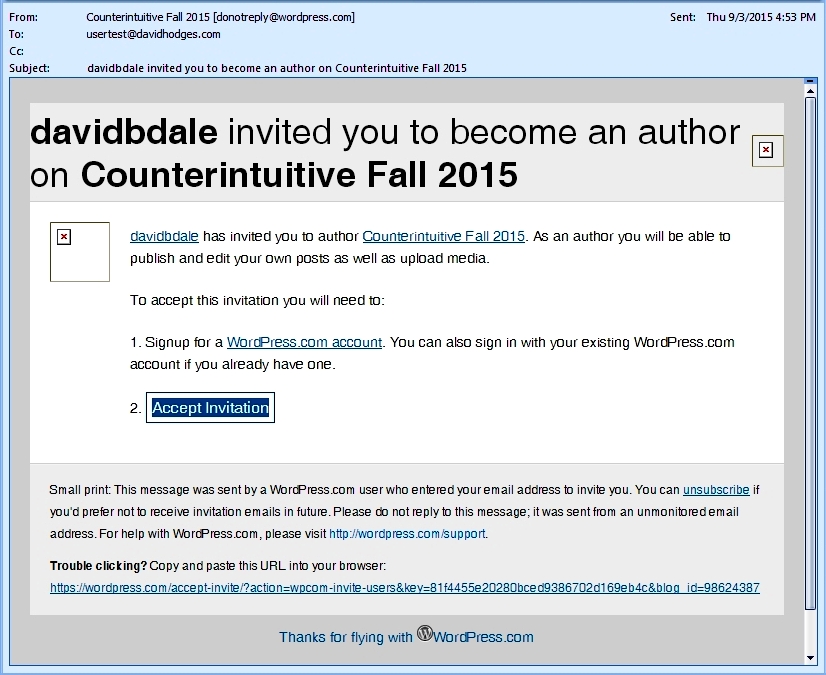
Step 9. Once you have a verified username, share it with me and I’ll invite you to the blog as an Author. You’ll receive this final email.

Blog User Invite

Step 10. Click Accept Invitation.

Haircut 1Teddy

Posted in davidbdale, Housekeeping, Professor Post | Leave a comment