A16: Portfolio Assignment

Contents

The Portfolio contains the following:

  1. 3000-word Research Position Paper
  2. Annotated Bibliography, 10-15 Sources
  3. Visual Rhetoric Rewrite
  4. Self-Reflective Statement
  5. Two of the following:
    • Definition Argument Rewrite
    • Causal Argument Rewrite
    • Rebuttal Argument Rewrite

Deadline

WED DEC 04 before class.

  • All 6 items must be in the Portfolio before class meets WED DEC 04.
  • During class WED DEC 04, we will conduct a “Portfolio Double-check” to verify that portfolios are complete.
  • When your Portfolio is certified, you may schedule your Grade Conference.

Grading

Your professor will have just a few days to read and grade the entire set of 44 portfolios in time for Grade Conferences. Therefore, penalties will be severe for any portfolio not complete by the end of class WED DEC 04.

Grade Conferences

The final days of scheduled classes, MON DEC 12, and WED DEC 14, will be devoted to personal one-on-one Grade Conferences. Conferences generally require less than 15 minutes, but are compulsory.

Visit the Professor Conference page (the same one we’ve used all semester) to schedule your end-of-semester Grade Conference.

Among other things, conferences provide the opportunity for professor and student to come to agreement about the student’s final grade. Students who miss their grade conferences will have little recourse to challenge those grades.

Posting Final Grades

Final Grades will be submitted shortly after Grade Conferences, probably on THU DEC 15.

Posted in Assignments, davidbdale, Professor Post | Leave a comment

Stone Money- luckyleprechaun1

In the NPR Broadcast called The Invention of Money, Jacob Goldstein put forth the idea that “money is fiction.” As a person with a vivid sociological imagination it is easy for me to understand the concept of money being a fictional one that we create. I would like to expand on this idea of the fictional nature of money by comparing and contrasting our own monetary system with one exceptionally foreign to ours and then considering what these similarities and difference imply, if anything.

In Milton Friedman’s essay The Island of Stone Money, Friedman talks about the financial system of a group of people living on the island of Yap in Micronesia.  In 1903 William Henry Furness III, an anthropologist, studied their way of life. He gave particular inspection to the Yap’s monetary system. The Yap used large stones called fei to make their purchases- the pricier the item, the larger the stone. The Yap are perfectly fine with not moving the large stone coins after a transaction is made but simply acknowledging that it is owned by someone new. We may think that Furness’ findings make the Yap appear primitive and humorous. However, it is only when we turn our scrutiny to our own monetary system that we find striking similarities between the Yap and ourselves.  

Like the Yap, Western society uses objects (namely dollars and coins) to make transactions and advance the economy. We can say that our objects are easier to handle, but the Yap do not live in industrial, overpopulated areas and are therefore fine with using large stones. The Yap’s system work perfectly fine for them. Also the Yap seem to be conscious, as are we, that money is but an abstract idea and while objects provide a concrete way of seeing it, money is kept in existence by society. In fact one family was able to claim they were wealthy because they had a large fei that was lost at sea when trying to transport it during a storm. Rather than saying the family didn’t own the fei anymore, the society believed the family and allowed them to maintain the purchasing power that stone would have lent them. Similar to how Western society has learned to represent money using paper checks and numbers on screens, the Yap (again, being a small scale society) is able to simply remember which stones belong to whom.

The similarities and differences between the Yap’s and our own monetary system open us up to the idea that money is socially constructed. This means that money exists because society says it does. Much like language, how money is expressed is a product of culture. For the Yap, large stones were naturally good material for currency because they were available and functional in the environment. In America, a fast-paced industrial society, millions of new dollars and coins are produced every day. Today we have Bitcoin, a digital currency system that doesn’t require any physical manifestation to be considered real and is a natural product of our high tech, digital lives.  Money is just as real and made up as language is. True, as individuals we cannot change either of these systems completely, but we can make choices in our own lives with how we spend money or use language and these little choices end up making what our economic and linguistic systems respectfully are.

Saying money is socially constructed is not to say that money isn’t necessary. We certainly wouldn’t be where we are today without it. But it does mean that without humans money would not exist. Money is not only part of the fictional universe (society) that humans create but it is also a huge part of its narrative. Narratives help humans understand and create the world around them. Countries are not simply in debt to other countries for no reason. There are events that transpire that cause the debt in the first place. This is true for any economic event or situation. It’s precisely because humans crave the continuity of a story that we structure our money, and frankly our entire lives in a sequential, story-like format. We keep track of who we give our money to, with the belief that we will be payed back in time.  None of these observations decrease the importance of money at all. Obviously, the story of our money emerges out of necessity and debt is necessary for a fair and just society. As long as we exist we are necessarily going to have money and therefore money will continue to remain a cornerstone of what makes us unique as a species.  But this does not change the fact that debt and other financial circumstances are socially created or that money is, in fact, a fiction.

Works Cited

Friedman, Milton. “The Island of Stone Money.” Diss. Hoover Institution, Stanford University , 1991.

Reeves, Jeff. “Bitcoin Has No Place in Your – or Any – Portfolio.”MarketWatch. N.p., 31 Jan. 2015. Web. 10 Sept. 2015.

Wade, Lisa. “Money as a Social Construction – Sociological Images.”Sociological Images Money as a Social Construction Comments. N.p., 24 Apr. 2014. Web. 10 Sept. 2015.

“The Invention of Money | This American Life.” This American Life. N.p., 7 Jan. 2011. Web. 04 Sept. 2015.

Posted in Stone Money Links | 3 Comments

Stone Money—ilovenas

After reading Island of Stone Money by Milton Friedman, I started to think about the actual real meaning of money. All these different thoughts started to surface in my head, for example, I asked myself if someone can actually be rich if they are not able to physically see all of their money. If you’re not in control over all of your money, how is it yours? Personally, I believe being rich and wealthy is a status or lifestyle.

The government of Brazil using the concept of fake money to help the country out of poverty was very deceitful, and although it worked, it goes to show that we the people really have no control over anything. This connects with the article, Money Matters by Teresa Murray, the article touches base on an interview with a man who was denied the access to withdraw his own money weeks. I think the fact that a man that worked hard throughout his whole life not being able to withdraw $600,000 from his account without a two-week notice is sickening, and adds to my point that money is a concept of our imagination.

Whether it be an enormous stone or pieces of paper, the only value money has is the value we claim it to have. It is simply a tool to keep us mentally enslaved by the government.

Works Cited

Friedman, Milton. “The Island of Stone Money.” Diss. Hoover Institution, Stanford University , 1991.

Joffe-Walt, Chana .

“How Fake Money Saved Brazil.” NPR.org. 4 Oct. 2010. 30 Jan. 2015. <http://www.npr.org/blogs/money/2010/10/04/130329523/how-fake-money-saved-brazil&gt;.

“Current FAQsInforming the Public about the Federal Reserve.” FRB: Is U.S. Currency Still Backed by Gold? N.p., n.d. Web. 10 Sept. 2015.

Posted in Stone Money Links | 3 Comments

Stone Money-Breadpatrol99

“Money, it’s a gas; grab that cash with both hands and make a stash.”
-Roger Waters

An idea that remained elusive to me during much of my life was the concept of money, and with good reason; as there is little in this world that compares to the paradoxical nature of modern capital. Consider for a moment, that while nearly the entire population of the planet believes in the value of paper money, the vast majority of it does not actually exist beyond numbers in a computer system! As Pink Floyd once philosophically noted: “Money, it’s a gas”.

While such a statement may be representative of how one sees money in a modern economy, such intangibility was not always the case. The article, “The Island of Stone Money,” by Milton Friedman tells of a small island in the Pacific, Yap, which stands as a peculiar example of the various conceptions of money over time. On this island, the currency is represented via absurdly large stone discs (the most valuable of which stood higher than the average human). These discs were sometimes too large to move easily and therefore would remain in place, and merely the owner would change. One of these discs even sunk to the seafloor during a storm, and the value of said disc is still uncontested. Someone owns it, that person has just never seen it before.

While the notion of these massive stone discs representing wealth may seem ludicrous at first, consider for a moment how modern economies consider money. Most of it does not exist! At least the massive stone discs were tangible, even at the bottom of the ocean! It seems almost hypocritical to label something as “silly” when our economy rarely shows itself. However, in modern times there is a new movement taking steps towards complete invisibility.

Bitcoins is an electronically based currency system used to transfer money unrestrained by space, made achievable through the internet. The possibilities seem astronomical when considering the nullification of paper money, though the implementation of a completely “valueless” currency is not something to be taken lightly. In the article “Bitcoin has no place in your-or any-Portfolio” Jeff Reeves explains the negative outcomes of Bitcoins becoming a recognized system of currency. He explains that while many see the idea of no central bank within the system as a positive, what it really means is “…a lack of true value”. In addition, Bitcoins would be a completely anonymous endeavor, leaving any thefts to remain largely untraceable. So while convenience is surely improved through bitcoins, the entire system of electronic currency remains largely questionable.

On the other hand, a National Public Radio radio broadcast titled “The Lie that Saved Brazil” discusses how after years of major inflation difficulty, Brazil finally overcame a financial crisis upon adopting a fully electronic system of currency alongside their tangible money. This virtual money saved Brazil from economic collapse, and reestablished faith in money among Brazilians.

Now this is truly bizarre. It seems upon initial glance as if there is no money, though when observing the current economic status of Brazil it is no secret that this little trick worked wonders. Brazil currently ranks among the highest economies in the world, after coming from one that failed horribly. It would appear that there is something to digital money. After all, how different is it than storing hoardes of money that does not exist beyond the numbers in a computer?

To be honest, my perception of the money system has not changed much from this literature on the subject. To me it has always seemed to be an insane idea based around human greed and more importantly: convenience (which in my opinion is the bane of any healthy society).

Works Cited

“Bitcoin Has No Place in Your – or Any – Portfolio.” MarketWatch. Web. <http://www.marketwatch.com/story/bitcoin-has-no-place-in-any-portfolio-2015-01-28&gt;.

“Bitcoin: What to Expect in 2015.” CNBC. 15 Dec. 2014. Web. <http://www.cnbc.com/2014/12/15/bitcoin-what-to-expect-in-2015.html&gt;.

Goldstein, Jacob, and Davd Kestenbaum. “The Island Of Stone Money.” NPR. NPR, 10 Dec. 2010. Web.

Friedman, Milton. “The Island of Stone Money.” Working Papers In Economics (1991). Web.

Posted in Stone Money Links | Leave a comment

Stone Money – crossanlogan

Currency can seem the most valuable thing in the lives of many Americans. For many of us, our entire lives revolve around the acquisition, use, or display of currency. At first, this love of money seems very reasonable; after all, we need to purchase food, clothing, shelter, and myriad other “tangibles” in order to have a “good life.” Our financial ethnocentrism is such that we balk at the idea that another culture’s currency could be as valid as ours. Friedman says in his essay that “[t]he money of other countries often seems to us like paper or worthless metal, even when the purchasing power of individual units is high” (Friedman 5). However, in the abstract it is clear that our currency is no more or less valid than that of any other tradition.

An NPR broadcast featuring Stanford University economist Milton Friedman examines this in more detail; Friedman talks about a tiny Oceanic island called Yap, whose inhabitants have a “non-standard” idea of currency (NPR). The Yap exchange “Fei” — sandstone discs of diameters ranging from a few centimeters to more than a meter. As a sandstone disc of that size is somewhat difficult to move, the Yap don’t bother; they simply make a note of which Fei belongs to whom. North Carolina State University anthropologist Scott Fitzpatrick is quoted by Goldstein and Kestenbaum as saying “[t]hey often talk about the stones themselves not changing hands at all. In fact, most of the time they wouldn’t” (Goldstein). Contrasted to our culture, that seems insane; we carry our money with us, of course! Why else do we buy wallets and purses if not as vehicles to transport or display our monetary wealth?

Upon closer inspection, though, it becomes apparent that the Yap are not as crazy as we thought. The Yap separate ownership from physical location, just as we do when we deposit our money into a bank account. The actual dollar bills are used to lend to other bank customers, and we may never physically see a specific dollar bill twice in our lifetime. Instead, a number is entered and a button is clicked, triggering the bank’s software runtime environment to convert a number into a string of binary bytecode, which is then sent to a router, and through a complex series of DNS lookups, IP addresses, and physical trans-continental cables is sent via the internet to a remote facility, sometimes thousands of miles away, which updates an integer value on a hard drive that nobody ever physically interacts with, and that is what we call money. And we somehow believe that our currency is superior to that of the Yap.

This begs the question, though — what is the value of currency? And even more absurdly, how can we maintain value between currencies? Ayton MacEachern says that “[h]ow much demand there is in relation to supply of a currency will determine that currency’s value in relation to another currency” (MacEachern). But ultimately that’s also just another arbitrary game of numbers, with hundreds of international exchange employees keeping track. And even that gets further abstracted by the concept of futures. “The futures markets,” says the Economist writer Marc Levinson, “allow participants to lock in an exchange rate at certain future dates by purchasing or selling a futures contract” (Levinson 15). We abstract the arbitrary value of stylized pieces of paper to the point of absurdity. To make this clear, corporations pay people in currency for simply knowing and understanding the currency system in which they live.

In the end, as much as we think our culture and our currency is more advanced that ultimately is not true when we consider the similarities to cultures which we think of as “less civilized.” Money only has value as far as we all agree that it has value, and separated from that agreement it is meaningless.

Works Cited

Friedman, Milton. “The Island of Stone Money.” Working Papers In Economics (1991). Web.

Goldstein, Jacob, and Davd Kestenbaum. “The Island Of Stone Money.” NPR. NPR, 10 Dec. 2010. Web. 09 Sept. 2015.

MacEachern, Ayton. “How Are International Exchange Rates Set?” Investopedia. Investopedia, 14 May 2008. Web. 09 Sept. 2015.

Levinson, Marc. “The Economist – Guide to the Financial Markets.pdf.” The Economist. The Economist. Web. 09 Sept. 2015.

Posted in Author, Stone Money Links | Leave a comment

The Pixies—Snakes

Posted in davidbdale, My Music | Leave a comment

Agenda WED SEP 09, 2015

Posted in Agendas, davidbdale, Professor Post | Leave a comment

E01: Bloated Paragraphs

Convert the bloated paragraphs into idea-rich, logically complex sentences. Begin the exercise in class, finish on your own time, publish your results below as numbered Replies.

Some paragraphs will resist reduction to a single sentence because they wander among too many main ideas. For those, write separate sentences, 5a and 5b for example, to indicate that the paragraphs might actually be multiple paragraphs.

Begin with 1. Work in teams if you prefer. I will circulate among you to check on your progress.

  1. Money or currency is a concept used all over the world, from 1st world countries to 3rd world countries. The idea behind one country’s idea of currency can be drastically different from one population to the next. For example there is an island off the coast of Australia named Yap where their form of currency is know as Fei. Fei is in the form of limestone which can range in size from a cd disc to a stone the size of a small house. The greater the size of the Fei the greater the amount of wealth the owner will have. Fei is found over 400 miles away from the island of Yap and many men expeditions using wooden rafts are needed to retrieve it. This is an extraordinarily different way to look at currency than in the United States. Some of the Fei are too big to move therefore when they change hands in ownership, they might not change location. The people on the island will have a mental note of who owns which Fei.
    .
  2. Money is fiction—that is, according to the dispositions and conclusions of certain outspoken individuals, including, primarily, reporters from an NPR broadcast and an economist from Stanford University by the name of Milton Friedman. These parties, and more, discuss the ideologies behind the concept of money and currency and how it differs and parallels among dissimilar cultures and different scales. Ranging from a tribal culture from an Island called Yap, to the modern United States Federal Reserve and even some samples that were on an international scale. They all seem to bring to light how intangible the reality of money actually appears to be and they write it off as fiction. However, anthropologically it would not seem so fictional, it may even appear beautiful.
    .
  3. An article I was reading about the giant stone currency of the Yap, and an NPR broadcast on the same topic, both claimed that our money compared to the Yaps’ money isn’t really different after all. We keep our money in our bank accounts which we then access using credit or debit cards to make purchases. When our money is in the bank it doesn’t sit there with our names on it; it is being lent out to other people. As the author of the article said, “Your bank account is just an agreement between you and the bank that x amount of money is yours. You take it on faith that the bank will have that money.” Same for the Yaps: they trusted that everyone knew whose stone was whose. Also something interesting I listened to in the broadcast was that the money you put into the bank is merely numbers on a computer screen. When you purchase something, physical money is not being transferred; just a few numbers on a computer are being changed. This can relate to the stones because the actual stone isn’t being moved, just the names of who owns them.
    .
  4. Just as it did thousands of years ago, money in our age still plays an important role in our society. In order for most of us in the United States and other countries around the world to live, we need money. We need money to purchase food to eat, need money to buy clothes to wear, and we also need money to shelter ourselves. Money today in the United States is determined by the government. They are the ones who give each bill its specific currency, like the dollar bill or ten dollar bill, as well as the metal coins. In other countries it’s the same way. For example, in the Philippines, the type of currency they use in their every day life is pesos.
    .
  5. In Milton Friedman’s essay, “Island of Stone Money,” he talks about the small island of Yap and how he was impressed with their monetary system that revolved around stone. I found an immediate contrast between American society and Yap society, as Americans believe gold to be much more valuable than stones would ever be. Unlike American society, Yap society considers stone to have value as we Americans value gold, which is why stone or as the Yap people may call it “Fei” is the currency of the island. As I continued to read the essay, I found it interesting that “it is not necessary for its owner to reduce it to possession.” Meaning if the stone could not be carried, the ownership would be switched, marked as a form of exchange, and left undisturbed. I was surprised to know how easy it was for the people of Yap to trust someone with their stone but I noticed that it isn’t any different than me putting my “money” into a bank account.
Posted in Assignments, Bloated Paragraphs, davidbdale, Professor Post, Required Reading | 28 Comments

Grade Levels II

I wrote two sentences recently that contain a paragraph of material each. They’re not perfect sentences, but their advantages over the paragraphs they represent make them fit models of writing that earns better grades. The magazine Mother Jones publishes a series of articles on counterintuitive ecological topics called Econundrums.

Grade-worthy 1

My favorite Mother Jones Econundrums puncture the inflated claims of greenness too often made by commercial operations determined to sell us something they pretend has big environmental advantages.

This sentence packs a lot of material and delivers it in a steady stream that needs no punctuation. Commalessness is not a requirement of good writing, but it’s good evidence of fluency, which I do require. Let’s unpack the sentence into its component claims.

The Unworthy Bloated Paragraph it Came From

Commercial operations are in business to sell us something. They know a large percentage of consumers would prefer to buy something that is kind to the environment. They will choose a green product over a similar but planet-killing product if they can find one. But companies don’t necessarily make the “greenest” products. Often they exaggerate the environmental friendliness of their products to trick us into making purchases that don’t really benefit the planet. Mother Jones Econundrums sometimes puncture the inflated claims of the companies that exaggerate their environmental benefits. Those are my favorite Econundrums.

Grade-worthy Example 2

Electric cars make me furious, for example, because their manufacturers pretend exhaust pipe emissions are the only measure of a car’s environmental impact, conveniently ignoring the damage done to the planet by producing the electricity in the first place, a huge percentage of which is lost to transmission line inefficiency before it ever gets to the car.

The sentence could be better phrased, but it’s certainly not as clumsy at the bloated paragraph it represents, which takes way too much space to spell out the same claims:

The Unworthy Bloated Paragraph it Came From

Electric car manufacturers claim that their cars are environmentally friendly. They claim that they cause less environmental damage than cars that burn gasoline. They support that claim by measuring only the amount of environmentally-damaging exhaust that gasoline engines emit when they’re driven. It’s true that their electric cars don’t emit gasses, but they are wrong to claim that exhaust gasses are the only way to measure environmental impact. The electricity required to power their cars is not environmentally clean because it can’t be produced in the first place without damaging the planet in some way. What’s more, a huge percentage of the electricity generated at power plants is lost in the miles of transmission wires from the plant to the charging station before it ever gets into the car. Therefore, claims that electric cars are cleaner than gasoline engine vehicles make me furious.

As I did at the close of the first Grade Levels post, I invite you to respond here if this is helpful, or if you feel the need for additional samples, better models, or even revised versions of your own paragraphs before or after you’ve posted them. If I can model better writing for you, I’ll be happy to try.

Posted in davidbdale, Professor Post, Required Reading | 1 Comment

Grade Levels

Grade Levels for Learners

…………… I won’t always be able to tell you why your essays don’t quite achieve the grades you want. Even after you respond well to feedback and make your essay grammatically correct, provide good sources, and make reasonable arguments, you might still not earn the highest grade. Writing beautifully and persuasively is more than a matter of following rules, and you may simply require more practice or more skill than can be achieved in a single semester.

Nobody wants to be told: “You just don’t sound as if you know what you’re talking about,” or: “You spend so much time proving the obvious there’s no room left for new insight,” but that may be the truth of the matter, and it may be the unspoken reason your grade didn’t improve as much as you hoped.

Following are some writing samples I hope will illustrate obvious differences in writing quality. The differences are enough to be worth a letter grade. These are relative values, of course, not absolutes. Not every writing course requires exactly this level of accomplishment for an A grade. Neither would the worst example necessarily earn a D grade in this course. Still, the comparisons should be helpful

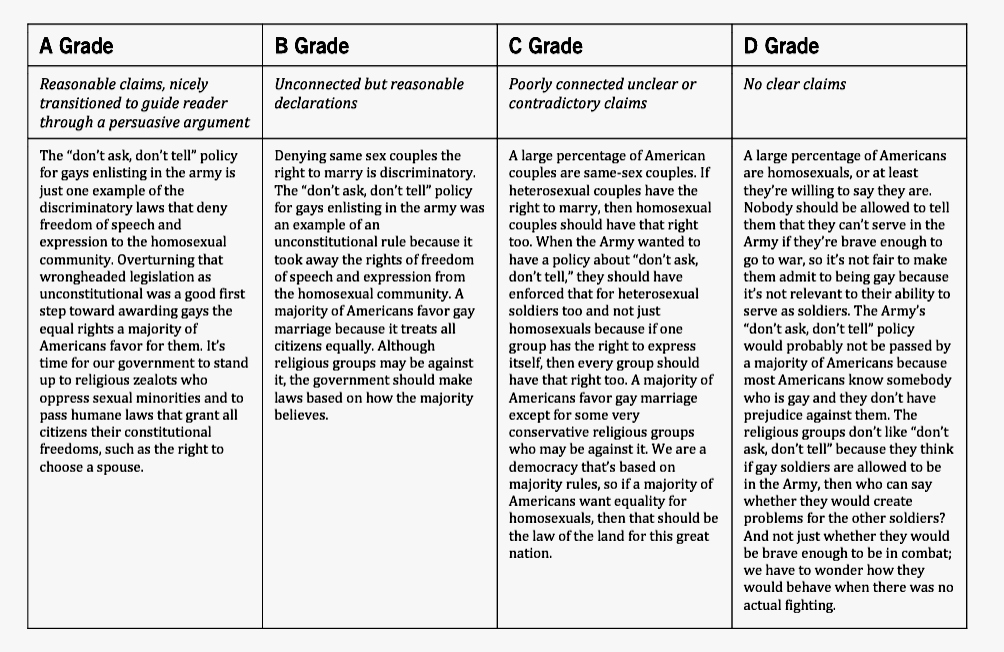
D Grade
No clear claims:

A large percentage of Americans are homosexuals, or at least they’re willing to say they are. Nobody should be allowed to tell them that they can’t serve in the Army if they’re brave enough to go to war, so it’s not fair to make them admit to being gay because it’s not relevant to their ability to serve as soldiers. The Army’s “don’t ask, don’t tell” policy would probably not be passed by a majority of Americans because most Americans know somebody who is gay and they don’t have prejudice against them. The religious groups don’t like “don’t ask, don’t tell” because they think if gay soldiers are allowed to be in the Army, then who can say whether they would create problems for the other soldiers? And not just whether they would be brave enough to be in combat; we have to wonder how they would behave when there was no actual fighting.

C Grade
Poorly connected unclear or contradictory claims:

A large percentage of American couples are same-sex couples. If heterosexual couples have the right to marry, then homosexual couples should have that right too. When the Army wanted to have a policy about “don’t ask, don’t tell,” they should have enforced that for heterosexual soldiers too and not just homosexuals because if one group has the right to express itself, then every group should have that right too. A majority of Americans favor gay marriage except for some very conservative religious groups who may be against it. We are a democracy that’s based on majority rules, so if a majority of Americans want equality for homosexuals, then that should be the law of the land for this great nation.

B Grade
Unconnected but reasonable declarations:

Denying same sex couples the right to marry is discriminatory. The “don’t ask, don’t tell” policy for gays enlisting in the army was an example of an unconstitutional rule because it took away the rights of freedom of speech and expression from the homosexual community. A majority of Americans favor gay marriage because it treats all citizens equally. Although religious groups may be against it, the government should make laws based on how the majority believes.

A Grade
Reasonable claims, nicely transitioned to guide reader through a persuasive argument:

The “don’t ask, don’t tell” policy for gays enlisting in the army is just one example of the discriminatory laws that deny freedom of speech and expression to the homosexual community. Overturning that wrongheaded legislation as unconstitutional was a good first step toward awarding gays the equal rights a majority of Americans favor for them. It’s time for our government to stand up to religious zealots who oppress sexual minorities and to pass humane laws that grant all citizens their constitutional freedoms, such as the right to choose a spouse.

I hope the value differences among these samples are obvious, and that you feel inspired by the differences to strive for the most specific, most logical, most persuasive writing to achieve your goal—not better grades, but an enhanced ability to get what you want from people by persuading them.

I don’t know any better way to demonstrate the difference between essays that earn different grades than to provide examples like this.

Click HERE to see the above examples organized into a nifty chart.

Click HERE to see SpongeBob’s take on Composition Class.

Please evaluate the effectiveness of this illustration with a Reply below. Thank you.

Posted in davidbdale, Professor Post, Required Reading | Leave a comment