:01 – There is a man. He seems to be snapping his fingers. His eyes are super wide. There’s a table. He’s looking at whatever is under the table. Maybe he’s trying to get his dog’s attention? He looks confused.
:02 – Still the same man. The camera angle barely shows his face. He’s still looking under the table. His eye brows are raised. His face looks as if he’s unsure of what he’s looking at.
:03 – Now there’s a woman. She’s pushing something. There seem to be children’s toys on the handle of what she’s pushing. I’m going to assume she’s pushing a child around in a stroller. She’s looking down, I can’t tell whether she’s looking at the child, or the ground of where she’s walking.
:04 – There is a woman. A man is standing behind her. She’s taking a picture of something. Everything is super blurry. Nothing is in focus. The man is wearing a flannel, it must be fall time.
:05 – Still the same couple. The lady is still trying to take a picture. The man is barely there anymore. You can only see half of the woman’s face. It looks like she doesn’t have a ring on her finger. Maybe they’re not married. There are a lot of shelves in the background. Maybe they’re collectors, or just very nice decorators.
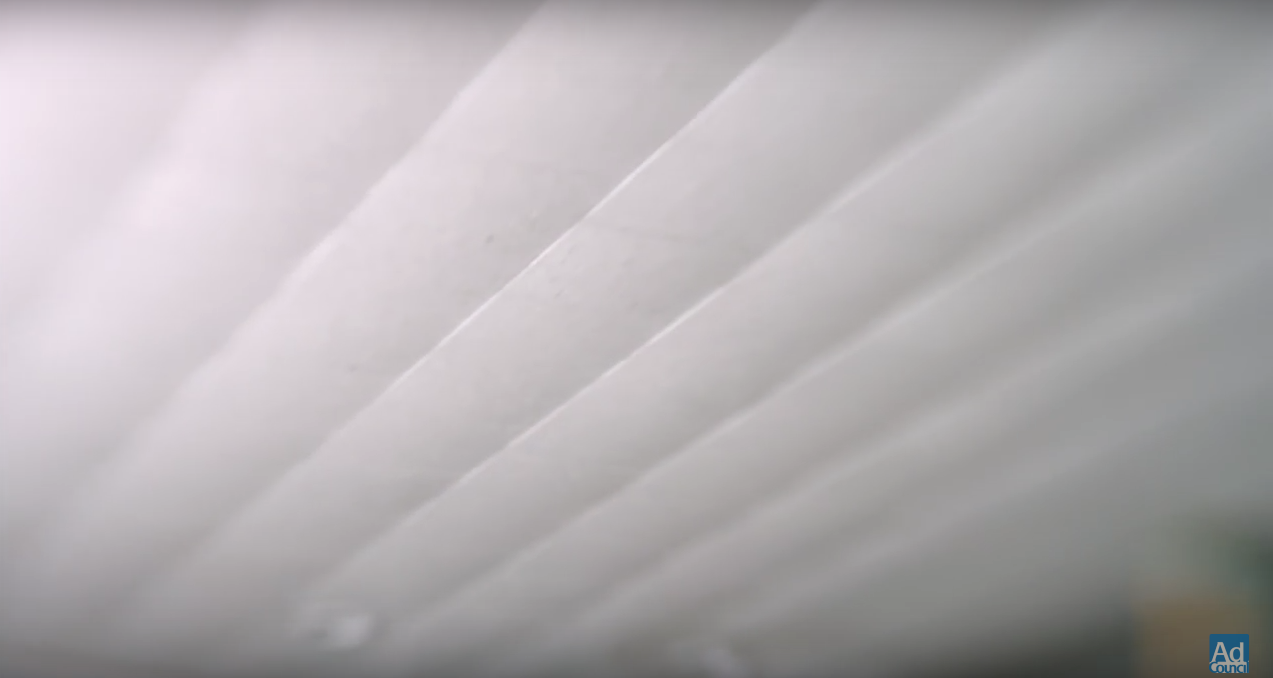
:06 – This is a very nice ceiling.
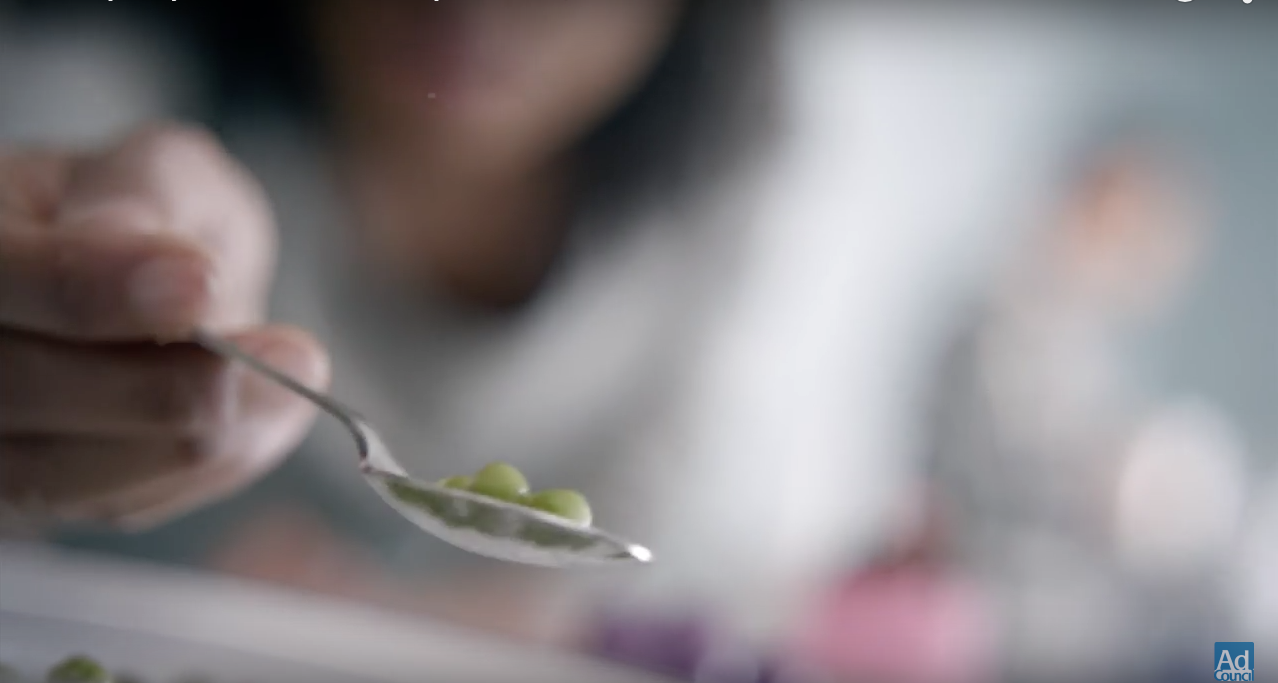
:07 – There is a woman. There are peas on a spoon. She’s either eating the peas or feeding them to someone. I’m going to assume she’s feeding a baby. It looks like a high chair. A lot is blurred out. I believe there is a person in the background, but I’m unsure. The spoon is the only thing in focus.
:08 – Still a woman, feeding a baby peas.
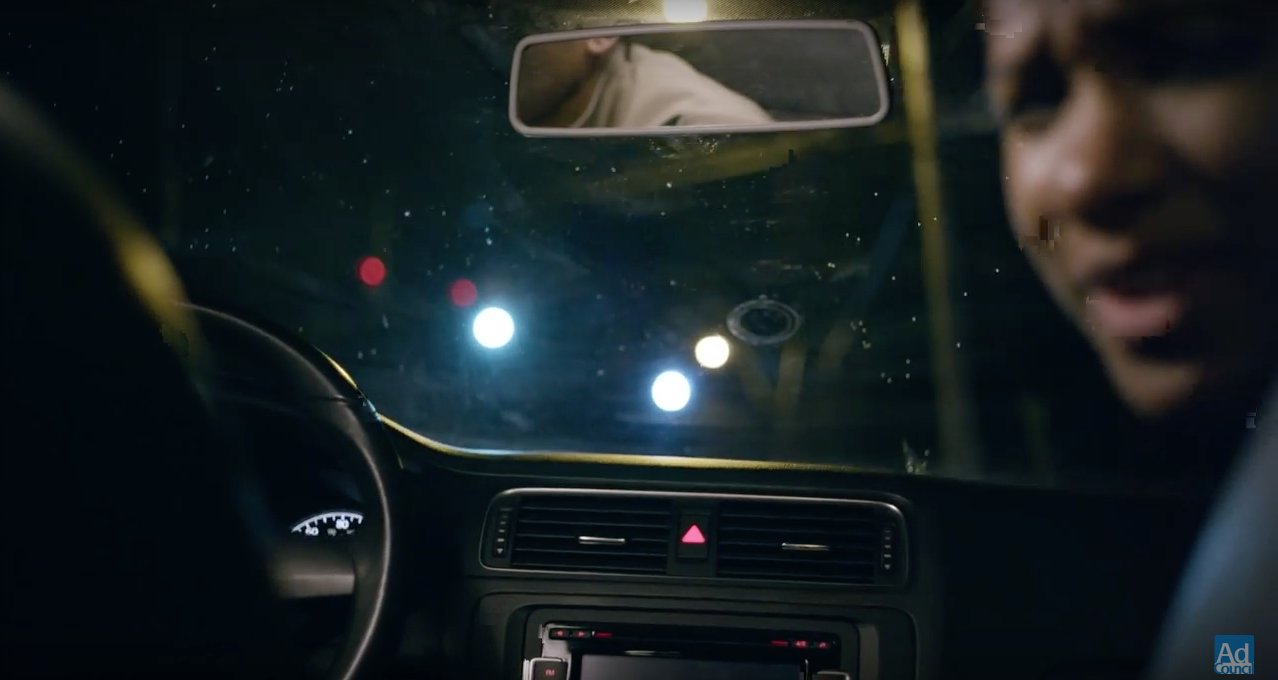
:09 – Now we’re in a car. There is a person in the passenger’s seat looking into the back seat. I can’t tell if it’s a man or a woman. They’re driving at night time. I can’t see the driver, maybe it’s a ghost driver. The face of the passenger looks very concerned, very confused.
:10 – The passenger is saying something. They’re still looking in the back seat. Maybe they’re yelling at they’re fighting children. Or maybe they have a pet in the back seat. His/her face still looks very concerned. It’s still night time.
:11 – I think the passenger is a woman, judging by her cheek bones. She seems to have a concerned smile on her face, but a smile nonetheless. They’re still in the car, they must be coming home from somewhere since it’s night time. She seems very invested as to whatever is in the back seat.
:12 – Definitely a woman. She’s shopping somewhere, I’m going to guess a grocery store considering she has a shopping cart. She’s for sure engaged, and by the size of her ring her fiancé makes good money. Her nails are done, so she must make good money as well. We can’t se her eyes. Her hands are the only thing in focus, everything else is blurry.
:13 – She’s showing off her ring. She has a smile on her face, so she must be happy. The shopping cart is the only thing in focus.
:14 – It’s a woman. She’s talking. Maybe she’s talking to herself. She’s wearing a sweatshirt, so maybe she’s cold. The camera is at a weird angle, so you can’t really see anything.
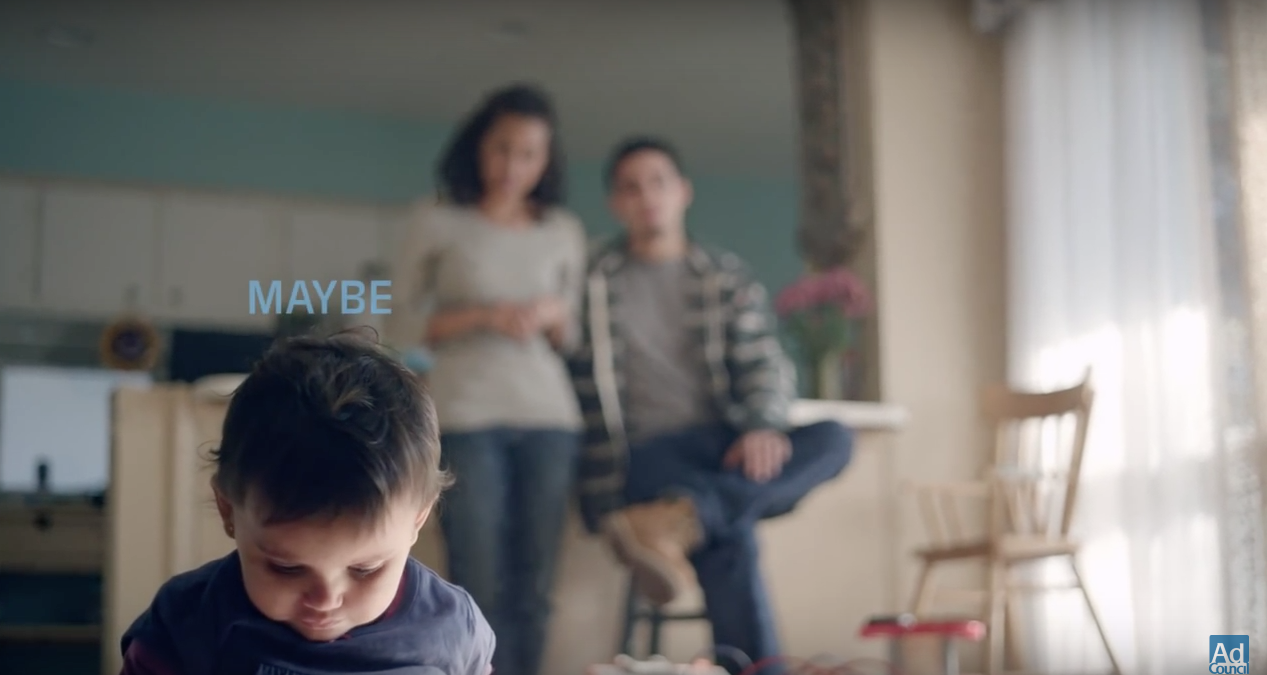
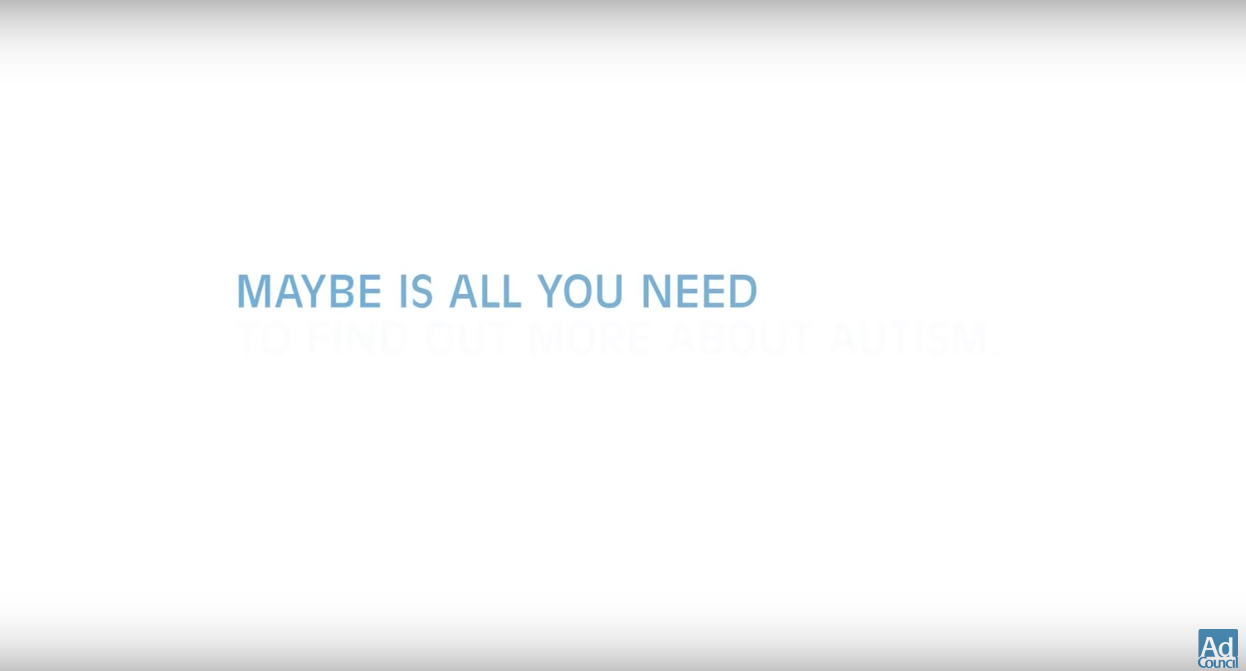
:15 – The child is in focus. I think the people in the back are the child’s parents. The word “maybe” is on the screen. I have no idea what it could possibly mean. “maybe” they’re not the child’s parents. “Maybe” the child isn’t a child, but it really an alien.
:16 – “Maybe is all you need” appears on the screen with a white back drop.
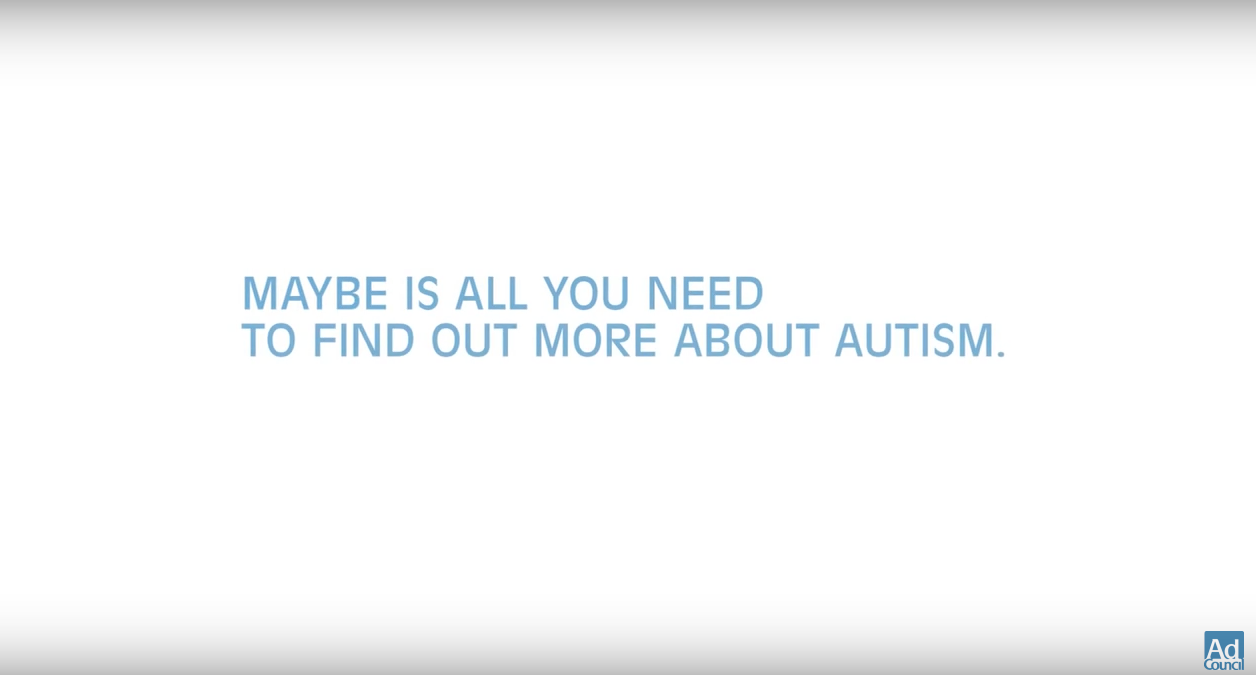
:17 – “Maybe is all you need to find out more about autism” appears on the screen with a white back drop. So now I’m assuming this whole commercial has to do with autism awareness. This stays on the screen for the next ten seconds.
:27 – So the commercial is about autism awareness.
The video opens with a closeup of two photographs. One is of a smiling young boy dressed in nice clothes, appearing to be a professionally done picture that parents often have taken of their children. The other picture has a glare on it and is more difficult to make out, but it looks to be of a young boy in another professionally done portrait, possibly a school or sports picture. It is not certain, but perhaps the two pictures are of the same young man.
0:03
The camera pans slowly to the left, revealing two additional photographs. One is of a couple on their wedding day, a black and white shot of a bride and groom dressed in their wedding attire, hands interlocked. They are mid dance. Below them is a picture of a young boy, assumingly the boy who is in the other pictures. So far, we have been shown pictures of what seems to be a family of three: a wife, husband, and their young child.
0:05
The camera, once again, pans slowly to the left. A dark silhouette of a person appears on a black and white staircase. The person’s gender and appearance is unclear.
0:06
The shadow is moving. Something is visible at the top of the staircase, blocked by the railings. Its colors are white, blue, and yellow.
0:10
As the camera moves up and over the railing, a little boy is revealed to be the thing that was blocked in the last frame. He is sitting on the landing of the stairs, holding a yellow toy truck. He wears pajamas. He is peering between the railings, down at something. This looks to be the boy who was in the photographs from the beginning of the video. He may be looking down at the person whose shadow was cast on the wall at 0:05.
0:12
The angle of the camera has switched to behind the boy now. We see him peering down at something, and we see the shadowy outline of a person’s head between the shadows of the railings on the wall to the right of the boy. Could this be one of his parents? We are now in a similar viewing position as the boy: we are voyeurs at the top of the steps, looking down. While he sees the actual person through the railings, we are only shown the shadows of what he sees.
0:13
The angle switches once again. Now, we are below the boy, looking up into his face. Half of his face is cast in a shadow. The boy seems to be hiding in the shadows, stealthily viewing from above what is going on down below. The boy does not look particularly happy. He looks to be in discomfort. His eyes look glazed, and his mouth is in a frown. From this close and personal vantage point, we can make out what is on the boy’s white pajamas: hockey players in different positions, making a pattern. His innocently youthful, light colored pajamas contrast starkly with his dark, shadowy, and seemingly uncomfortable position.
0:16
He fidgets and moves his gaze from what he was originally looking at to his lap now, presumably at the toy truck he is holding. Evidently, he did not like the actions of the person he was watching.
0:19
The boy convulses in fright as a look of shock appears on his face. He quickly moves his eyes from down at his lap to the source of the action, which is back to between the railings. A loud noise is likely the culprit of the surprise the boy exhibits, since one tends to jump and look shocked when a startling sound is heard.
0:21
The boy looks back and forth below him, his eyes shifting from left to right. He scrunches up his face for a brief instant in obvious disapproval of whatever it is he is seeing.
0:24
The screen fades to black, and white words appear against the black background: “Children have to sit by and watch. What’s your excuse?”
0:28
Different words materialize: “There’s no excuse for domestic violence.” A phone number, 1-800-END ABUSE, is placed below.
The video’s message is that children suffer as they sit by and watch their parents argue, or as one parent afflicts abuse on the other. It is trying to encourage the end of spousal abuse by showing it through the sympathetic eyes of a child who must witness it. Through the visuals alone, I did not find this ad to be too clear with its intent. I gathered that the boy was the same person as the child in the photographs, and that the married couple were probably his parents. Throughout the video, one shadow only can be seen. I inferred that this was of one of his parents. As he looked down from the stairs, I was confused as to what he was seeing. I knew he was looking at a person, but I didn’t realize two people were down there. The ad could have visually displayed the abuse through silhouettes. The husband’s shadow could have been shown raising his hand to strike his wife. This would have made a striking visual, and the purpose of the ad could be realized through sight alone, rather than solely through the sounds of the pleading woman.
The following is a visual review of a one-minute long anti-texting-and-driving PSA by the Ad Council, titled “Put it Down.” The video in question can be found here.
At the very beginning of the video, at 0:01, we see the scene of a young boy, perhaps six years old, in what appears to be a park, judging by the shovel, monkey bars, merry-go-round, and slide that are shown in the background. The entire scene is drawn in the style of an amateur artist, with each black line segment on the white background being rather crude, but clear enough to make an obvious picture. The boy is playing with a toy car. Given the context of the PSA, this is an obvious case of foreshadowing. The audience must immediately question if the young boy will be killed in a texting-while-driving-related accident, or if another character to whom we have not yet been introduced will meet an untimely demise.
Three seconds later, at 0:04, another boy of the same approximate age has joined the original, and is now seated to the right of the first boy. He has a toy car of his own. Both boys are smiling, and clearly enjoying themselves and the company of one another. Again, the context of the PSA must be taken into consideration: which boy will die in an accident? Or, to be particularly morbid, will both boys be killed? For that matter, can anyone be certain that either boy will lose his life—what if more characters are brought into the story?
Only a second later, at 0:05, a disembodied arm appears from the left side of the screen, and motions for the first boy to come. One assumes that it is the hand of a parent, perhaps a mother—the hand looks slightly feminine. Each boy wears a sad expression upon his face. At 0:06, the first boy is being dragged away as the boys happily wave goodbye, smiling to one another. The audience may assume that the boys have formed a friendship, although there is nothing to suggest that they could not have been friends already.
By 0:12, the boys have each moved to separate sides of the screen. The entire background is white, with a black vertical line splitting the center of the screen. This serves to show that the boys are in separate locations, although they are in reality only a few pixels apart. They both appear to be slightly older than in the beginning of the video, perhaps around the age of twelve. Each boy is smiling, looking slightly downwards, and each holds a phone in his hand. Above the first boy, there is a speech bubble coming from the phone in his hand. Inside the bubble, one sees the words “NEW TEXT MESSAGE” centered at the top. Beneath this phrase, it says, “Hey, wanna come over and play some video games?” It is unclear if the boy is sending or receiving the message, but the fact that each boy holds a phone is clear evidence that the two friends are having a conversation via text message.
Two seconds later, at 0:14, a similar speech bubble appears above the second boy, containing the words, “Sure, be over in a bit :)”. Because of this, the audience can now determine that the first boy was in fact sending his text message, as it would not make contextual sense for the boy on the right to send a question and then the answer to his own question. For three seconds, the divisive line disappears, and the boys are shown to be in the same location. They sit on an unremarkable couch, facing the camera, presumably with a screen of some sort in front of them, although this cannot be seen by the audience. Each boy holds a gaming controller of sorts. After a brief sequence of the boys demonstrating some very animated facial expressions (excited ones from the left boy, and desperate ones from the right), both boys drop their controllers at 0:18 as the boy on the left throws his hands above his head with a joyous grin—a clear gesture of victory. Conversely, the right boy is frowns and holds his right arm over his eyes, in an ashamed display of defeat. After this, at 0:19, the boys stand, and the line appears. Once again, the two boys appear to have aged, each looking to be around the age of 15 or 16. It is evident that the friendship developed in the beginning of the story has lasted over the years.
At 0:22, the speech bubbles have returned, and the boys are once again separated on blank backgrounds. The boys smile at their phones, as the left boy sends a text that asks, “Hey man, what time is practice today??” The boy on the right responds at 0:24 with, “6:00. See you then.” While the text message seems brief and impersonal, the audience can assume that the boy is not angry with his friend, as both are smiling. Rather, it can be assumed that the second boy is simply choosing to answer his friend’s question briefly. At 0:25, the boys are shown to be in the same area once again—it appears to be a grassy field, which makes sense when considering the first boy’s earlier question. From 0:25 to 0:28, both characters are wearing football uniforms and helmets, as the right boy throws a football to the left boy, who catches it. Interestingly, the separating line in the middle is still present here, suggesting a more permanent divide between the boys. Why is this? What is to become of the two characters?
At 0:30, the boys have returned to their white backgrounds, and again seem to be older than in the previous sequence. They each appear to be approximately 18 years of age. The boys are both smiling at their phones, while the boy on the right asks via text message, “Wanna catch a movie with me and the guys tonight?” At 0:32, the left boy replies with, “For sure, be there soon!” Two seconds later, at 0:34, the boys have moved again. The boy on the left is shown behind the wheel of a car, evidently on his way to his friend’s location. The second boy leans against a wall, with his arms folded comfortably, awaiting the arrival of his lifelong friend. While both are originally smiling, the boy on the right begins to frown at 0:35, slouches lower at 0:36 and by 0:38 has reached into his pocket and texted his friend, asking, “Are you coming??” Meanwhile, the boy on the left is still in his car.
At 0:39, the driving boy looks down with a mildly interested facial expression, apparently having received his friend’s text message. He reaches into his pocket, but then looks up in horror, as if seeing something that is not shown to the audience. What is the matter? Why is the boy frightened? This question is soon answered at 0:40, as the boy’s side of the screen is suddenly filled with thick, dark, scribbly lines, and then becomes entirely black. This is clear evidence of a car accident. Recalling the original question at the beginning of the video, it now becomes clear that the toy car was foreshadowing the first boy’s own death due to texting while driving.
By 0:43, the remaining boy looks quite concerned, and he has taken his phone out of his pocket. “Where are you?” asks the speech bubble above him. At 0:45, he is standing up straight, no longer slouched against the wall. He looks distraught, and a new speech bubble is coming from his phone. “Are you okay?” it says. He continues to stand, looking quite concerned. By 0:47, the second boy’s side of the screen is also black. This is clearly the most effective part of the video, as it shows a lifetime of friendship being destroyed in literally one second of real time, due to the careless acting of texting while driving.
The screen remains black for one second, and at 0:48, a simulated sequence is shown. It depicts the yellow dotted lines of a road, moving towards the camera. It is partially lit, as if by headlights. This is a clear depiction of a first-person view from a car windshield. In the center of the screen, the words “PUT IT DOWN.” can be seen in white letters. At 0:51, the words are replaced by “SAVE YOUR LIFE.” The road sequence continues for the rest of the video, as the url for stoptextsstopwrecks.org replaces the command at 0:54, as well as the logos for the Ad Council, Project Yellow Light, N.O.Y.S. The video ends at 0:59.
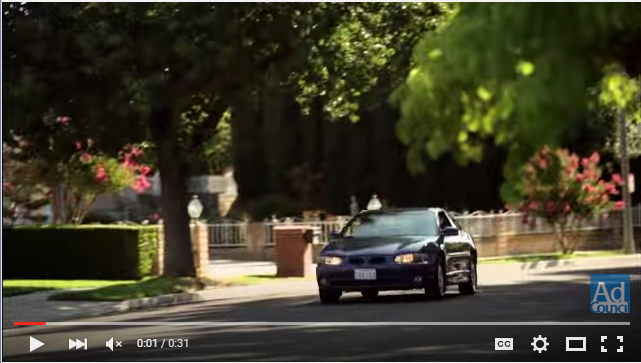
A not too old, black car drives down what it looks to be a quiet and well off neighborhood. The driver is not shown in the shot as the car drives.
0:03
A young blonde girl, maybe a junior or senior in high school is driving the car. She seems happy and is paying attention to the road ahead of her.She has both hands on the wheel. It can be assumed that she knows how to drive well.
0:05
In the next second after the girl is shown, there is a screen that is showing a new text message. The shot is specifically focused on the fact that the girl got a text message. The screen is extremely zoomed in.
0:06
The blonde girl driving is now looking down, her eyes not on the road. She is most likely looking at the phone somewhere nearby in the car. She looks as if she is contemplating on whether to look at the phone or not.
0:07
The girl then looks back up to the road as she continues to drive forward for a few seconds, ignoring the fact that she has a message on her cell phone.
0:10
The young girl is now reaching for the phone, it appears to be in a cup holder. The focus of the shot is on the cell phone and not the girl. It seems as if the cell phone is empowering everything that is happening.
0:13
The girl is now smiling and looking down. Her eyes are not on the road anymore. Her mind seems to be captured by the looking and replying of the text message shown at the beginning.
0:16
The screen not focused, it seems blurry. The girl has the cell phone in her hand, it is on and there is a keyboard showing. It seems as if the picture is in motion.
0:19
The focus of the shot is on an intersection, it seems as if the viewers are seeing the intersection from the inside of the car. This intersection during this moment does not have any cars. There is a stop sign.
0:20
The view is now from an outsider’s perspective. Now at the intersection has the girls car and another new car. The cars are not too far apart from one another. Within another second the cars look like they can easily crash into each other.
0:22 The screen reads in “Stop the texts Stop the Wrecks” in all caps. The girl in the video must have crashed into the car in the intersection because she was distracted by a text message.
All Students please read before posting your own draft.
.
Thank you again for being the first to post, haveanelephantasticday! I won’t ask you to always be first because to do so would place an unfair burden on you, but I’m happy that you’ve elected to be first again; you do good work and set the bar high for those who follow you. That said, I will of course have plenty of suggestions for improvement/revision/enlargement that I hope will be helpful to you and to others.
0:01 There are two hands, each are holding very full glasses of wine. Imagine please that you are the reader, not the writer, of this line. What would you understand, and what would you not understand? Describe the image well enough so the reader can visualize it accurately. Are they hands of the same person? Hands of two people? Male hands or female? Holding glasses before their bodies? The glasses: are they wine glasses? (Sounds silly, I know, but just because they contain wine, they don’t have to be wine glasses. And just because they’re wine glasses, they don’t have to contain wine.) The arms: do they indicate that the hands hold wine above their owners’ heads? In front of them? If there are two people, one hand each, are the people facing one another? How much of them do we see?
GRAMMAR: Each is singular; both is plural. Each IS holding a glass. Both ARE holding glasses. .
0:03 The hands are coming together in slow motion, possibly for a “cheers”. Presumably a momentous occasion that inspired a celebration? You write well, haveanelephantasticday. I love your “presumably a momentous occasion that inspired a celebration.” If you could tell us, either at 0:01, or here, that the hands (and glasses) are approaching the middle of the screen from opposite sides, one left, one right, we’ll have a better chance of seeing the scene correctly. You are entirely correct to say that the glasses approach in slow motion, but for what purpose, do you suppose? Why does the director make this choice? Is it to insure that we will not miss the collision? Is it to give us time to anticipate the collision? Is it to trick us into thinking that the meeting will be a slow and soft one? You may not even have these questions in mind when looking at the first three seconds, but at some point in the viewing, you’ll start to subconsciously react to the repeated slow collisions. Is it possible (this is REALLY thinking ahead) that the director wants to emphasize how our perceptions are altered by wine, beer, whiskey? We think we’re driving at a safe speed, but in reality the collisions we cause are MUCH more violent than we would have predicted?
PUNCTUATION: the period ALWAYS goes inside the quotation marks. ALWAYS. Even when the quotation is a single word. SO: “cheers.” NOT: “cheers”. .
0:06 The glasses are clinking for their cheers. It’s good to isolate this moment because it is the last moment of the “expected.” The first time we see this video, we believe the action to be a simple clinking of glasses. To this frame, we are comfortable with that interpretation. .
0:07 The glasses came together for a cheers but when they touched, they shattered. There are pieces of glass flying all over. Its hard to tell why they crashed because they seemed to be coming at each other slowly. Precisely right. Our expectations are shattered. The slowness of the approach fooled us. We are not prepared for the violence of the impact. There is wine everywhere too, don’t forget. The contents of those vehicles are spilled as well. Maybe here is the right place to make observations about the questions I asked back at 0:03.
PUNCTUATION: Its is a possessive like his and hers; that’s why it doesn’t need an apostrophe. It’s is a contraction for it is. Use it’s, with the apostrophe, wherever you mean it is. SO: It’s hard. NOT: Its hard. .
0:15 There are now two glass mugs full of beer that are coming together for “cheers”. These glasses are also coming in at slow motion. Are they being clinked with the same force as the first set of glasses? That’s one good question. Another is: are these the same hands? Are the same people drinking both wine and beer? And what about those mugs (not glasses)? You neglect to mention the logos they sport. Is there significance to them? Why repeat the same sequence of images with a second alcoholic beverage? Is any point being made by using two intoxicants in a row? The shattering point has been made. What’s new about the repetition?
STYLE: Consider streamlining your language by eliminating needless words. There are now two glass mugs full of beer that are coming together for “cheers.” EQUALS: Now two glass mugs full of beer are coming together for “cheers.” .
0:16 When these mugs clink, they also shatter everywhere. Why? This could be a 15-second spot without the repetitions. What makes it worth 30 seconds? .
0:22 There is a third set of glasses, these are full glasses of brandy that are coming in the “cheers again”. Will the people monitor their cheers so that a shattering of glasses may be avoided? I like this question very much, haveanelephantasticday. Having seen the collisions twice result in catastrophe, we’re right to wonder if the “hands” have learned anything. Same hands? Are we expecting the same two people to have learned? Or is it possible others can learn from watching the first examples without having to experience crashes themselves? In other words, analyze the visual not just in terms of what it shows; analyze also your (our) reactions to it as we watch. You’ve begun to do just that with your rhetorical question: Will people monitor?
BARTENDER TIP: Brandy? On ice in a rocks glass? You think so? .
0:23 A hand appears and intercepts the collision of the two glasses. On the top of the screen, the words “Drinking and driving can kill a friendship”. The glasses may represent car collisions that may occur if drinking continues. I love the brevity and clarity of “intercepts the collision.” How do your readers visualize this? Do they get a clear picture? Explain briefly your logic following from “drinking and driving can kill” to “the glasses represent car collisions.” I know it seems obvious, but the claim is big and important. Can you reconstruct the steps your mind took on first viewing? .
0:28 The glasses do not collide and there is no shattered glass. Offer a final thought on the effectiveness of the spot. Did the visual sufficiently deliver its intended message(s)? Did it make avoidable mistakes? Could it have been done better? Was it as satisfying/dissatisfying/effective/ineffective on successive viewings?
A fine first draft of a first draft, haveanelephantasticday! Thank you again for posting early and giving me a chance to respond long before the deadline. I hope you find these notes helpful.
When I ask you to analyze a visual argument from film or video, imagine you are describing the images to a reader who can’t see what you’re describing. You may understand the creator’s intentions and the complexities of the narrative, but since you’ve learned them from watching the visuals, the reader will have no basis to evaluate your judgements unless you describe the visible components of the Visual Argument.
For readers who are not watching along with you, you are not sharing what needs to be shared by saying: “since he has no money.” We don’t understand how you know this, and therefore we can’t trust your conclusion. Much more effective and to the point, explain that “he turns out his empty pockets to indicate he has no money.” Now we’ll understand what part of the argument was conveyed by the images.
Evaluate the Rhetoric
It’s also your responsibility to indicate whether the technique (the rhetorical part of the visual argument) is effective or not. One of the images below conveys cashlessness without unnecessary distractions. No money, pure and simple. The others inject extraneous and potentially confusing notes of sensuality or degradation. One is rhetorically singular. The others may be effective, but only if the cashless person is supposed to be shapely, or fit, or seedy, or disturbing.
As viewers, we’ve been trained to be widely receptive to the nuances of images. The best communicators limit the range of interpretations we can impose. When it’s your turn to analyze a visual, you’ll need to gauge how effectively the intended messages are delivered, how much the noise has been reduced.
Sample Argument Analysis
Let’s examine just ten seconds of vidcaps from a sample video and see how much we can extract from looking at a portion of an argument we don’t already know.
Looking at silent stills from the video this way, without knowing the context, and without the distractions of the soundtrack or narrative significance, we’ll have to concentrate exclusively on the images alone, at the rate of one per second, to see how we’re being manipulated.
1:44
A young Asian man, probably outdoors in a city, is dressed casually and wears a backpack. He is either not well shaved or has deliberately chosen the unshaven look for fashion’s sake. His hairstyle is neat but casual and his open shirt and undershirt are clean, so the impression we get is that he is not poor or homeless but that he chooses to dress for an informal effect. He carries a pen in his pocket: industrious or at least prepared. He is looking down, either to see the curb, or something on the sidewalk, or at least something below eye level, perhaps in his hand.
1:45
By this frame, we’re seeing a hint of something brown and rectangular in his hands. Our immediate impression is that it’s a wallet but we can’t be sure. Passport? Map? It is clearly occupying his attention, but also he is still walking, so he must know where he’s going; otherwise, he’d have to be more careful stepping. So: will he be spending money on something he routinely buys?
1:46
Here, instead of seeming to be involved in a routine, the man looks surprised. His open mouth might indicate he wants to ask a question. His narrowed eyes give the impression he wants to focus carefully to make sure he’s seeing what he thinks he’s seeing. That combination of confusion and disorientation might indicate he is worried about what he’s seeing.
1:47
A woman is looking up. We assume she is looking at him, and that, given the angle of their communication, she must be standing in a deep hole, or seated on the ground, sidewalk, or curb before a pedestrian barrier that subtly suggests prison bars. Is she trapped or confined?
The fact that he walked right up to her without worrying about where he was going indicates he is accustomed to finding her here (and perhaps that he uses his wallet when they meet).
She is perhaps his age or a bit older, not much. She is not disheveled or unclean, but neither is she fashionable or “put together.” Her drab open-collar shirt might even indicate she’s poor. She is clearly quite troubled from the furrowed brow and pressed eyebrows. Her hands are folded too. Has he interrupted her at prayers? Or is she asking (begging) for something from him?
1:48
The camera pans down to reveal that she is in fact sitting on the ground, more specifically on a piece of cardboard torn from a shipping carton as we can tell from the torn die-cut handle. In other words, she’s sitting on some trash she brought here for this purpose.The cardboard is wider than it needs to be for her. Next to her is what we might call, an “empty seat.” Is she perhaps waiting for him to join her? Or has she lost someone? Is it possible he has always given her money (the wallet? the sure steps in her direction?) and that her being alone is surprising or disturbing?
But that can’t be. Unless a person just got up from this “seat,” the cardboard wouldn’t be folded out to the woman’s left. She’d fold it under herself. What can it mean? Did someone just disappear from this street corner?
It would have to be someone intimate, even related. Friends or acquaintances would have their own cardboard; they wouldn’t share.
1:49
The word “Mom!” appears as a subtitle, with an exclamation mark! Not a label, then, but someone’s call. Somebody is calling Mom. Oh no. Has the man’s mother always sat here on this bit of cardboard where the man visits her often, but today she’s gone, sick, injured, missing? If she’s dead would the cardboard still be there? If she’s nearby, what has happened?
1:50
The woman, hands still folded, looks up. Has she heard someone call Mom? The implication is that she might be responding to the call, but does that mean she’s Mom? Or that she’s looking to see who might be calling out? The man, we presume is still directly in front of her, so she’s looking off to the side, not at him.
1:51
When the man spins to his right, he is clearly looking down the sidewalk. The woman, when she looked up and turned to her left, must have been looking down that same sidewalk. His mouth is still open. He still has unanswered questions. His eyes are focused on the distance so we guess he’s looking at someone standing fifty feet away or coming in his direction. Is it the person who called out Mom? The woman’s child?
1:52
It’s a schoolgirl in an unmistakable schoolgirl uniform. The bit of stitching above the pockets is probably the name of the school. Like the man and woman, she’s Asian, a girl of six or seven maybe? An early elementary school child.
Her untucked shirt and the straps of her blue backpack are clear echoes of the young man’s outfit. Maybe that’s why he has a pen in his pocket. He could be her teacher.
But her shirt is neatly pressed, maybe the nicest garment in the video. It cost money to buy and to keep clean. The school she goes to costs money. Does the man (her teacher?) pick up this child on the way to school every morning? Was she just momentarily away from the corner on an errand? She called out Mom!, we now assume, but in the right of the frame, the man’s clothes are visible.
She could have seen him as well as her mother on the ground. So this can’t be Dad, right? Unless she now calls out Dad! She looks radiantly happy. Is she just a joyous adorable child, or has she been separated from Mom and happy to be back?
This shot confirms we are in a city. The row of barred barriers at the curb echo the one behind Mom on the sidewalk. They either protect pedestrians from runaway cars or they’re a place to lock up bikes.
The girl’s hands are empty, so she hasn’t been sent on an errand to fetch something for Mom. Is she possibly coming back from school? Good God, what if this bit of cardboard is home? How would she stay so clean?
1:53
She stops dead in her tracks on the sidewalk in reaction to something not frightening but important. She doesn’t turn and flee or seem afraid. She doesn’t look back and forth from Mom to the man and back; she can handle this on her own. But she doesn’t proceed any further forward either. She is processing something at this distance. From the angle of her eyes, we know she’s looking not at Mom but at the face of the standing man.
1:54
The camera is moving slowly in her direction. Since we are seeing her from the man’s perspective, this means we are “taking a closer look at her,” moving carefully from the distant stranger position to a closer proximity where we are comfortable with people we know.
If this is her customary spot on the cardboard, the man must have been disturbed to see her missing. Now that she’s here, we should expect to see relief if we get another look at him.
1:55
What’s going on here? He looks just as confused as ever. Is he relieved to see the child he was worried was missing, gone, or hurt? Why is he not smiling at the sight of her? If he’s her Dad, this is a very inappropriate facial expression. But clearly she’s not meaningless to him. He has an interest in her.
Conjectures, please.
The Argument in Context
Now, let’s watch the argument in its entirety to test our hypotheses.
Review and Recommendation
This analysis of just ten seconds of video will remind you, I hope, what a rich medium is video for argument. We have discussed countless implications of the contents of individual frames, all of which are small claims in a larger argument. We can’t be sure how we’re being manipulated until we understand the entire argument, but watching pieces out of context gives us the best opportunity to see the mechanics of argument at work. When we watch in the “proper” sequence, with the “appropriate” soundtrack, we can be sure we’re being manipulated, and that we’re willing conspirators in our own persuasion. We’re hoping for a rewarding experience. Do we get goosebumps, or choke up with emotion, after 2 minutes of wordless video about total strangers? That doesn’t happen by accident. That happens when we’ve been persuaded by an argument to believe that something has happened (or that it at least represents a human experience that could happen).
As you prepare your Visual Argument, watch the videos as if you didn’t already know the argument.
Consider what a single frame communicates without its full context (which has been supplied to you by the video’s creator, whose job is to persuade you).
Create your own posts to include this degree of analysis and interpretation.
Decide for yourself whether to analyze the entire video, or, as I have here, just a few seconds that are particularly persuasive.
What is the Argument’s Purpose?
The text at the conclusion says: Thai Life Insurance. Believe in Good.
So, is it a public service announcement that urges us to make small differences in the world we pass through every day? No. It is not. It’s an ad for life insurance.
Make no mistake, this message from an insurance company is designed to sell men a life insurance policy to protect their children.
I admit, that sounds like an outrageous claim. You watched the video. You most likely didn’t feel you were being encouraged to buy life insurance. I didn’t either. WHILE I WAS WATCHING IT. While I was watching it, I was compelled to follow the logic of the narrative; I was swept along by the soundtrack, instructed when and what to feel; I was manipulated into seeing the patterns in the repeated images: three times the bananas on the doorknob. And so on. I was being taught something unwittingly.
Given time to reflect, though, I have decided this:
Paying for a life insurance policy every month, which does me “no direct good,” but which benefits my dependents when I’m gone . . .
is VERY MUCH like:
performing small but significant acts of generosity—such as making regular cash contributions from a light wallet with no tangible benefit for myself—for a little girl whose mother sits alone on a piece of cardboard with no father in sight and a dependent daughter to put through school.
That’s right. The young man is “paying premiums” that add up to a cash benefit for the girl whose father is gone. The young man is the stand-in for the father who dies but who has left behind a life policy with a death benefit that will put her through school.
That’s why the emotional payoff of the piece hits first when the man realizes he has helped “his little girl” get her education when there’s no one there to sit next to Mom.
OK? Get to work. Tell me a story like that one about the video you choose to analyze.
I prefer David or Dave, but students uncomfortable with first names can call me Professor or Mister Hodges. (Sir Dave and Dave-a-lot are popular alternatives.) My ESL students' charming solution, Mister David, is my favorite by far.











 Dev
Dev Joe Gramigna
 adamreim
 alexmoran17
 alivewit55
 americangods01
 anonymous123
 Anonymous
 azntaco
 belldere
 bigcounrty609
 bigfoot9
 bj112295
 blueee04
 breadpatrol99
 brxttyb
 calamariii
 cfalover
 charlieclover
 cherries267
 chickendinner
 chickennugget246
 chickennugget444
 clevelandbrown03
 cocochanel715
 comatosefox
 crossanlogan
 cswilliams15
 dancingueen
 disneylover2002
 doglover846
 dontquoteme187
 douglasadams525
 dt2018
 faded26
 friendoftacos
 frogs02
 fromcasablanca
 fulcrum66
 g00dsoup
 giants19
 gingerbreadman27
 girlno3
 gobirds115
 goodmusician440
 gracchusbabeuf
 hiralp365
 ifurreadingthisits2l8
 ilovedunkinoverstarbucks
 ilovenas
 imaspookyghost
 inspireangels
 JalenHurts4Mvp
 jasrielle2
 jcirrs
 jonnyb25
 eagles21
 kilotoon
 kingofcamp
 krackintheneck
 Philip Ebenezer
 Lily4Pres
 littlecow24
 ljkvng34
 lokiofasgard24
 luckyleprechaun1
 marinebio18
 Matt Loesche
 mellowtacos
 miliwawa
 minutemen14
 mossmacabre
 music0392
 mymomshouldhavenamedmegrace
 ndb1996
 neferpitou626
 nugget114
 oatmealvibes
 ohearnj8
 palal24
 peachesxo
 pinkheart84
 pinkmonkey32
 pitandthependulum22
 queenrandom04
 RowanAnnouncer
 Rowan27
 rowanluver29
 rowanstudent6
 saltysurfer322
 saycheese03
 Senpai Pio
 sixfortyfive645
 sortableelms
 spaghettitacosforthesoul
 strawberryfields4
 suedejackson
 sunflower0311
 sunshinegirl457
 tarheel1999
 teddysdoggydaddy
 thatwonguyy
 themildewmuncher7
 Public Display Name
 thirdlady226
 Thomas Laperriere
 tmjj4345
 toastedflatbread22
 tpaz1
tpaz1 tristanb50
 twofoursixohtwo
 tyblicky2001
 venom2929
 vicarij0
 wakeup5am
 Water
Water wildcuttlefish
 wizzard201
 xchuki
 Lunaduna
 zeek
zeek ziggy026
 zinny11
 zipemup1
 zoeyzoey0210
 zzbrd2822
 Counterintuitive Spring 2023