The Truth about Pandemic Puppies
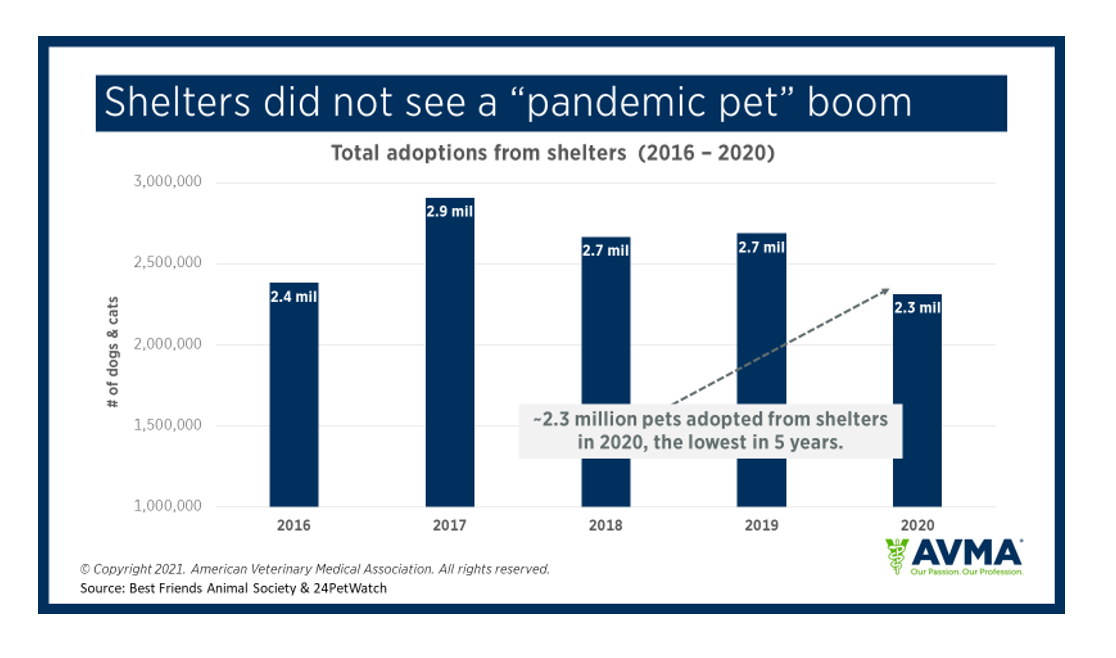
The unbearable loneliness caused by covid 19 drove many to adopt dogs they are incapable of attending to after their lives pick back up again. However, Matthew Solois, the director of veterinary economics, chooses to ignore that many dogs remain homeless after COVID-19. Solois argues that 2020, the year COVID-19 began, had the lowest pet adoptions from shelters in 5 years. This information is poorly backed up by statistics that show only a percentage of all the dogs brought home that year. The Bar Graph he presents his readers with shows a large incline in pets adopted from 2016 to 2017. Since 2017 the number of adoptions has slowly gone down to about the same number of adoptions in 2016. What Solois fails to tell his audience is that dogs don’t only come from shelters, they also come from stores, pregnant pets, backyard breeders, foreign countries, and kennels. Solois acknowledges that there are other means of adoption when he states “Although shelters aren’t the only source of new pet adoptions, they’re the primary source.” yet chooses to hide the amount of other options from his audience. It is true that the biggest form of purchasing a pet is adoption, but that doesn’t mean all of the other options combined don’t make up for a large percent. Solois knows what he is talking about but uses the correct information and twists it to fit a false narrative. No Matter where you got your pet from, the only place you can return it to is a shelter.

Solois shares that there were 32% fewer dogs adopted but fails to tell us what year this is in comparison to. This is because fewer people gave up their pets, in the beginning of the pandemic. All major adoptions happened after the effects of covid settled in.
Jobs that cater towards animals were affected during COVID-19 and that created a large chain reaction. Solois informs us that right before this time, programs were doing good with spaying and neutering to keep breeding down, however once they were no longer keeping up with that because of COVID-19, the dog population skyrocketed. Breeders also play a big role in this because they have been a huge reason for reproducing. They will never spay or neuter dogs because this inhumane job is to breed dogs as much as they can before the dog is unable to carry any more puppies. This cruel job was unfortunately not drastically affected by COVID-19. Fortunately these puppies were in very high demand and were being snatched up immediately. Solois completely ignored how big of a part breeders played in the pandemic by giving no statistical evidence about breeders. Dutch Pet says that according to ASPCA a whopping 34% of animals are adopted from breeders alone.
It’s not that there weren’t dogs to adopt, it’s that they weren’t being counted for. Rescue teams who rely on purely donations, were stuck dealing with an overwhelming amount of dogs because of Animal control not being able to work. Solois claims that it was harder to adopt because the physical process of adopting dogs became limited to virtual meetings or fewer visitors in the shelter at a time. This however limits how thorough home checks can be making the process of adopting that much easier. Fewer people will get denied from adoption when background checks are less intense. When it was this easy to get a dog, the population that is not fit to care for an animal is able to pass all the qualifications needed and these poor dogs ended up in the wrong hands and would soon see the shelter again. Solois admits later in his lousy argument that “ some shelters may have observed individual adoption numbers increase and veterinary practices did see an uptick in visits from new pet owners in 2020.” He then completely discredits that information by saying “on a national level, there doesn’t appear to have been a dramatic increase in pet adoptions.” Solois again fails to recognize that in order to find a nationwide average you have to take into account all the low dog population areas, like major cities. New York City has a population of around 8 million people and according to Kaelee Nelson, a content manager at Pawlicy Advisor, there’s a ratio of 71.97 dogs per 1,000 residents but yet there’s a shocking 104 animal shelters. This will lower the statistics tremendously leading to false reports made by ignorant people. There is no reason to take nationwide data when the main focus should be the shelters and communities that are struggling.
References
Matthew Salois, PhD, and PhD Gail Golab DVM. “The Covid-19 Pet Adoption Boom: Did It Really Happen?” DVM 360, DVM 360, 23 Sept. 2021
Coston, D. (2022, May 23). “Pet adoptions statistics: Facts & Faqs.” Retrieved April 19, 2023.
https://www.pawlicy.com/blog/best-cities-for-dogs/
Nelson, K. (2021, December 28). “Best U.S. cities for dogs: Pet-friendliest places in 2023.” Retrieved April 19, 2023


 Dev
Dev Joe Gramigna
 adamreim
 alexmoran17
 alivewit55
 americangods01
 anonymous123
 Anonymous
 azntaco
 belldere
 bigcounrty609
 bigfoot9
 bj112295
 blueee04
 breadpatrol99
 brxttyb
 calamariii
 cfalover
 charlieclover
 cherries267
 chickendinner
 chickennugget246
 chickennugget444
 clevelandbrown03
 cocochanel715
 comatosefox
 crossanlogan
 cswilliams15
 dancingueen
 disneylover2002
 doglover846
 dontquoteme187
 douglasadams525
 dt2018
 faded26
 friendoftacos
 frogs02
 fromcasablanca
 fulcrum66
 g00dsoup
 giants19
 gingerbreadman27
 girlno3
 gobirds115
 goodmusician440
 gracchusbabeuf
 hiralp365
 ifurreadingthisits2l8
 ilovedunkinoverstarbucks
 ilovenas
 imaspookyghost
 inspireangels
 JalenHurts4Mvp
 jasrielle2
 jcirrs
 jonnyb25
 eagles21
 kilotoon
 kingofcamp
 krackintheneck
 Philip Ebenezer
 Lily4Pres
 littlecow24
 ljkvng34
 lokiofasgard24
 luckyleprechaun1
 marinebio18
 Matt Loesche
 mellowtacos
 miliwawa
 minutemen14
 mossmacabre
 music0392
 mymomshouldhavenamedmegrace
 ndb1996
 neferpitou626
 nugget114
 oatmealvibes
 ohearnj8
 palal24
 peachesxo
 pinkheart84
 pinkmonkey32
 pitandthependulum22
 queenrandom04
 RowanAnnouncer
 Rowan27
 rowanluver29
 rowanstudent6
 saltysurfer322
 saycheese03
 Senpai Pio
 sixfortyfive645
 sortableelms
 spaghettitacosforthesoul
 strawberryfields4
 suedejackson
 sunflower0311
 sunshinegirl457
 tarheel1999
 teddysdoggydaddy
 thatwonguyy
 themildewmuncher7
 Public Display Name
 thirdlady226
 Thomas Laperriere
 tmjj4345
 toastedflatbread22
 tpaz1
tpaz1 tristanb50
 twofoursixohtwo
 tyblicky2001
 venom2929
 vicarij0
 wakeup5am
 Water
Water wildcuttlefish
 wizzard201
 xchuki
 Lunaduna
 zeek
zeek ziggy026
 zinny11
 zipemup1
 zoeyzoey0210
 zzbrd2822
 Counterintuitive Spring 2023