Visual Rewrite – wakeup5am

:01 Before: There is a man. He seems to be snapping his fingers. His eyes are super wide. There’s a table. He’s looking at whatever is under the table. Maybe he’s trying to get his dog’s attention? He looks confusedScreen Shot 2015-09-14 at 12.30.05 AM

After: This is a black man. He’s looking under the table. It’s a wooden table. I have a wooden table in my kitchen, so I’m going to assume he’s in a kitchen. The table is round so it’s definitely a kitchen table. And since it’s kitchen table he must be in house, not necessarily his own house. However, I”m going to say it’s his house, because he’s comfortably going under the table to get somethings attention.  He seems to be trying to get attention of something under the table. Could be a dog, a cat, or a child. He looks very confused, but yet at high alert. He’s snapping his fingers.

:02 Before: Still the same man. The camera angle barely shows his face. He’s still looking under the table. His eye brows are raised. His face looks as if he’s unsure of what he’s looking at.Screen Shot 2015-09-14 at 12.30.19 AM

After: Still the same man. His eye brows are raised so that can mean many emotions. He could be confused, worried, alert, surprised, scared, and/or hungry. He’s still looking at something under the table, but he’s not snapping his fingers anymore so maybe he got the thing’s attention. The camera angle doesn’t show his whole face.

:03 Before: Now there’s a woman. She’s pushing something. There seem to be children’s toys on the handle of what she’s pushing. I’m going to assume she’s pushing a child around in a stroller. She’s looking down, I can’t tell whether she’s looking at the child, or the ground of where she’s walking.Screen Shot 2015-09-14 at 12.30.31 AM
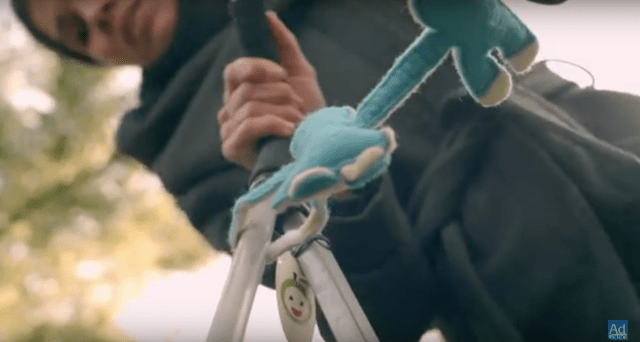
After: This is a lady. I’m unsure of her race, but I can see that she’s not white. By the looks of the children’s toys on the handle bar of what she’s pushing I’m going to assume she’s pushing a stroller. Since she’s pushing a stroller, I think it’s safe to say there is a child in there. Only her right hand is in the photo, so we cannot tell if she’s married or not. She’s looking down in the photo, far right. Her face is expressing some kind of stress or exhaustion. Maybe she walked too much, pushing her stroller, and now she’s tired. Maybe she had a long day at work, now she’s taking her child for a nice stroll to release her stress. Her nails aren’t painted though so she hasn’t had much time to herself. It must be cold if she’s wearing that jacket. The toys on her stroller are blue, so maybe she has a baby boy.

:04 Before: There is a woman. A man is standing behind her. She’s taking a picture of something. Everything is super blurry. Nothing is in focus. The man is wearing a flannel, it must be fall time.Screen Shot 2015-09-14 at 12.30.44 AM

After: There is another lady. She is of color. She’s taking a photo of something. Her left hand is in the picture and I spot a wedding band, so it’s safe to assume the man standing behind her is her husband. He is also of color. Everything is super blurry. The man’s shoulder is the only thing in focus. There are a lot of shelves in the background. She could be taking a picture of something because she got a new frame and wants to put it on her shelf.

:05; :06 are the same still frame.

:07 Before: There is a woman. There are peas on a spoon. She’s either eating the peas or feeding them to someone. I’m going to assume she’s feeding a baby. It looks like a high chair. A lot is blurred out. I believe there is a person in the background, but I’m unsure. The spoon is the only thing in focus.Screen Shot 2015-09-14 at 12.31.21 AM

After: This is a new woman. There seems to be a different person in every frame. This lady is white. She has peas on a spoon, but her arm is extended so she’s feeding someone or something else. There seems to be a really faint person in the background on the right. It looks like a white male. The lady’s right hand is pictured, so I can’t tell if they’re married or not. The table doesn’t look like a normal kitchen table, it looks like a high chair. I’m going to assume she’s feeding a baby, because only baby’s eat peas fed to them by a lady. The only thing in focus is the spoon. Maybe the baby is super hungry and that’s why it’s the only thing in focus.

:08 is the same still frame.

:09 Before: Now we’re in a car. There is a person in the passenger’s seat looking into the back seat. I can’t tell if it’s a man or a woman. They’re driving at night time. I can’t see the driver, maybe it’s a ghost driver. The face of the passenger looks very concerned, very confused.Screen Shot 2015-09-14 at 12.31.40 AM
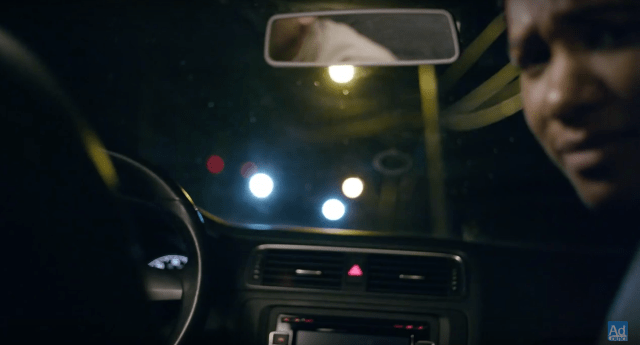
After: Now we’re in the car. There is a person in the passenger’s seat looking into the back seat. I can’t tell if it’s a man or a woman; however, they aren’t white. There is a person driving the car, I can see them in the rearview. I can’t tell the race because the mirror is too small. The passenger looks concerned, maybe annoyed, looks like he/she has to fart. It’s dark outside, the street lights are on. Maybe they’re getting back from dinner, or a movie, maybe their parent’s house. Whatever the passenger is looking at in the back seat, it must be something serious. I’m thinking a puppy or a child. Nothing is really in focus except the steering wheel.

:10; :11 are the same still frame.

:12 Before: Definitely a woman. She’s shopping somewhere, I’m going to guess a grocery store considering she has a shopping cart. She’s for sure engaged, and by the size of her ring her fiancé makes good money. Her nails are done, so she must make good money as well. We can’t se her eyes. Her hands are the only thing in focus, everything else is blurry.

Screen Shot 2015-09-14 at 12.32.25 AM

After: And it’s nothing woman! This one is white. She has a shopping chart, so i’m assuming she food shopping. She has a beautiful ring on her finger, but I only see an engagement ring, not a wedding band. We can assume she is someone’s finance. Her nails are also done, so she has time to take care of herself. The ring is a nice size, so they make money. Nothing is in focus except for the shopping cart handle. The lady is looking down towards the shopping cart. She could be looking at whatever is in the cart, or at the floor.

:13 is the still frame.

:14 Before: It’s a woman. She’s talking. Maybe she’s talking to herself. She’s wearing a sweatshirt, so maybe she’s cold. The camera is at a weird angle, so you can’t really see anything.Screen Shot 2015-09-14 at 12.32.44 AM

After: A different woman. She’s not white. She’s talking, but I don’t know if it’s to herself or if someone is with her. She has one a sweatshirt. Maybe she’s cold, maybe she just came back from the gym. I can’t see her hands to see if she’s married or not. I have no idea what is on that table, but it doesn’t seem to have any importance since it’s blurred out. There seems to be a pattern with all the still frames. There’s only one focus in every frame, and it’s never the person. In fact, the people in the frames are being pushed to the outside and out of the picture.

:15 Before: The child is in focus. I think the people in the back are the child’s parents. The word “maybe” is on the screen. I have no idea what it could possibly mean. “maybe” they’re not the child’s parents. “Maybe” the child isn’t a child, but it really an alien.Screen Shot 2015-09-14 at 12.33.50 AM
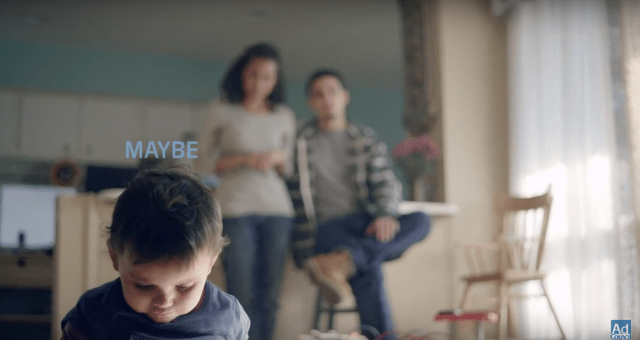
After: Now that I see the child, and I’ve already seen the commercial I have a better sense of what it’s all about. It’s safe to assume the man and woman in the back of this picture are the child’s parents. The parents are not in focus, but the child is. So i’m going to say the commercial is all about the child. It’s about all children. The word “Maybe” is on the screen. “Maybe” is a very unsure word. Maybe the parents are unsure about their child. The parents are just kind of looking into the child’s direction. Maybe she’s playing and they think it’s adorable. The child’s parent’s don’t wish to play with her.

:16 Before: “Maybe is all you need” appears on the screen with a white back drop.Screen Shot 2015-09-14 at 1.45.25 AM
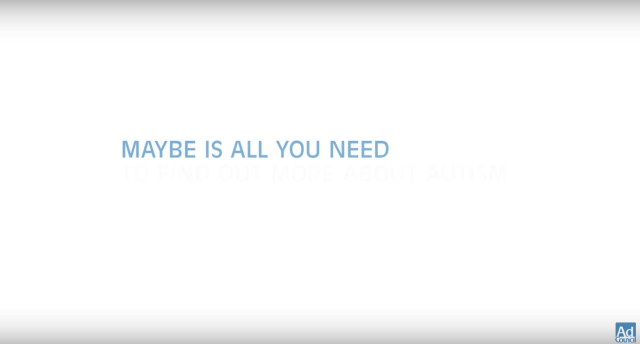
After: “Maybe is all you need,”appears on the screen. This is implying that if you’re second guessing anything you need to go find answers. If you’re thinking “maybe I have to try outs tonight!” You should probably go if you want to make the team. So “Maybe is all you need,” is basically saying, if you’re saying maybe you need to go find answers right away and turn that maybe into a yes or no.

:17 Before: “Maybe is all you need to find out more about autism” appears on the screen with a white back drop. So now I’m assuming this whole commercial has to do with autism awareness. This stays on the screen for the next ten secondsScreen Shot 2015-09-14 at 1.46.47 AM
After: “Maybe is all you need to find out more about Autism,” It’s pretty self explanatory.

:27 Before: So the commercial is about autism awareness.Screen Shot 2015-09-14 at 1.48.45 AM
After: The commercial is clearly about autism awareness. In the beginning the man is trying to get his baby’s attention, but the baby cannot focus. The second lady, although her facial expression was concerned, her still frame wasn’t as much help as the others. However, she follows the pattern of adults being pushed out of each still frame. The next one is the black lady with her husband. She could have been taking a picture of her child for keepsakes or something; however, the eyes of the child that we’re seeing through keep looking farther away from her and her husband. Up next is the woman with the peas. She didn’t do anything specific. However, her feeding peas is how I knew there is a child present. And then the lady in the car making her way out the the right side of the still frame and slowly fading out. The lady with the ring is most definitely a mom. She has on a mom sweater. Next is the woman talking, she was the only one that was no help for guessing the commercial. She has no emotional attachment to anything in the still. She’s just kind of speaking out loud. And now to tie it all up with the last picture, they finally show the child. Showing that there is a child presents helps everyone to understand that this whole time, we were looking through the eyes of a child with autism.

Posted in You Forgot to Categorize! | Leave a comment

E04: Critical Reading- wakeup5am

  1. Brannan Vines has never been to war. But she’s got warrior’s skills
    1. Maybe she’s just a bad ass, and she’s always on high alert.
  2. But her husband, Caleb, was sent to Iraq twice … came back with PTSD.
    1. Okay so Caleb is the soldier of the family, and he has PTSD from the war.
  3. Is PTSD contagious?
    1. It looks like an ad, but I’m guessing it has to do with the article.
  4. Caleb has been home since 2006 … enough time for Brannan to catch his symptoms.
    1. He’s been home since 2006, and this article was written in 2013. “Enough time to catch his symptoms” They’re talking about PTSD as if he has the flu and she’s going to catch it. PTSD is an anxiety disorder; you can’t just catch symptoms from someone else’s anxiety.
  5. “Some spouses and loved ones suffer symptoms that are – ‘almost identical to PTSD except that indirect exposure to the traumatic event through close contact with the primary victim of trauma.’”
    1. This is basically saying that if I have PTSD and my symptoms are out loud, my spouse and/or loved ones could experience my symptoms with me.
  6. “She mirrors… she just mirrors”
    1. This shows that Katie looks up to her father. She sees what he’s going through and she does what he does. Caleb may sometimes have random flashbacks that cause him to act out of yell a lot. So Katie, not knowing her daddy has flashbacks, sees his actions and wants to be like her father.


Times up.

Posted in Critical Reading PTSD | Leave a comment

Stone Money – wakeup5am

Who invented money? Who came up with the idea that “this one bill will cost more than 19 of these bills?” Growing up we are trained to believe that money is of importance. No matter what we do in our life, it wouldn’t be possible to do it if we didn’t have money to do it with. On the Island of Yap, they came up with the idea to use coins made of stone as money. Not only were they little pieces of limestone the size of a quarter, they also had giant pieces of limestone bigger than cars. Researches don’t know how limestone started out as money; however, the island of Yap noticed that they needed something to store value, to pay for things. And that is when the idea of stone money came about.

The people of Yap did not use the stone money for every day purchases, it was only for dire needs. Also, stone money being as big as it is, weighing more than a car, it was never exchanged from one person to another. It was just left in one spot and switched owners ever so often. NPR, “The Island of Stone Money” tells a story about a work crew bringing over a giant stone on a Yap boat, but it was dropped in the ocean when a big storm hit. When the crew told everyone on the island what had happened, everyone on the island decided that it was still good and it belongs to the crew workers, even though it was at the bottom of the ocean. No one has ever seen this piece of stone in over 100 years, but someone still owns it to this day.

In Brazil they used “fake money” called URV’s (unit of real value) to stop inflation. NPR’s article, “How Fake Money Saved Brazil”, they talked about the sticker man who walked the isles in the grocery store to higher the prices and people would race the sticker man so they could pay the old prices. A man named Edmar Bacha was called to save the economy of Brazil. He stated that people were the problem and needed to be tricked into thinking that money had value. They made a virtual currency called URV and it was stable. People would still use cruzeiros, but everything was listed in URV’s. Pretty soon prices started to mean something to people and the fake money became real money. After that inflation did end.

Bitcoin is virtual money. It’s a “peer-to-peer” system. It’s also anonymous. NPR’s article “What is Bitcoin?” written by Jacob Goldstein and David Kestenbaum, helped me learn a lot more about it, but I still don’t fully understand it. They state the best way to get bitcoins is to buy it. They started with buying 1 bitcoin for 7 dollars. After two weeks it went up to $23.80. Awhile later the site was shut down so they couldn’t buy bitcoins. Later the broadcasters went to a man named Bruce Wagner who helped them set up an account on MyBitcoin. They didn’t have to put any personal information in there, just a username and password, completely anonymous. Ronald Mann, a professor at Columbia Law School, states that they’re legal for now. Mann also says that in five or ten years it won’t exist. Apparently you can use bitcoins in Manhattan. Later after the broadcast, bitcoin was robbed and had to shut down.

Money is a weird thing in this world. The idea that people just agree on something having more value than something else, whether it be a piece of paper or a rock, is crazy. The story of the rock at the bottom of the ocean is so fascinating; the fact that no one has ever seen it, but it is still own by someone. NPR compared it to online accounts, which is very true. How people can go shopping online and nothing is exchanged, but the values in your online bank because lesser or more. As humans we set our lives around money, we go to school, we work, all to find a way to make more money, that most of us never even see. How do we know that we’re even being paid if we never actually see I with our own eyes? Do we just have to have faith that the numbers in our bank accounts don’t lie? Pretty soon the idea of money will be just that, an idea. Cash won’t exist anymore and America will just rely on credit and debit cards.


Freidman, Milton. “The Island of Stone Money.” Diss. Hoover Institution, Stanford University, 1991.

Goldstein, Jacob. Kestenbaum, David. “What Is Bitcoin?”. NPR.org. 25 August 2011

Joffe-Walt, Chana. “How Fake Money Saved Brazil.” NPR.org. 5 Oct. 2010.


Posted in Stone Money Links | Leave a comment

Rebuttal Rewrite – mymomshouldhavenamedmegrace

There are moms who volunteer to make a hundred cupcakes for the school bake sale. There are moms who coach the soccer team when no one else steps up. There are moms who lose sleep making sure their child has the best art project at school. And there are moms who breastfeed their kindergartners. No parent is perfect, and striving to meet the needs of children can get hazy along the way. For mothers who are fans of attachment parenting, however, a solution to almost any child’s meltdown is always readily available. Despite its many consequences, women continue to breastfeed their children into their elementary years with strong refutations against those who disagree, believing that it is a good way to raise a child providing comfort, confidence, and love.

Breastfeeding an infant is natural, it provides health benefits, and it is a form of bonding between mother and baby. These advantages can carry a child through their first year of life, but when they are able to eat solid food or comfort themselves, a mother might feel unwanted. This is where attachment parenting comes from. Sleeping alongside your child, known as co-sleeping, and homeschooling are characteristics of the attachment parenting lifestyle taken on by many modern day parents, but a recent addition has heads turning. Breastfeeding children well past the normal age is becoming more and more popular, thanks to women believing that it will answer all of their problems as a parent and more. A May 2012 cover of TIME magazine left 26 year old mom Jamie Lynne Grumet under scrutiny, depicting the woman  breastfeeding her preschool aged son. She states that she, as a child breastfed until the age of six, had a very secure feeling of confidence and love throughout childhood and strives to pass that nurturing environment on to her two children. Grumet is not alone in her thoughts and actions. Australian mom Maha Al Musa publicly spoke out in May of 2015 about her experiences with extreme breastfeeding, arguing that because her six year old likes it so much, she will continue as long as needed. Her daughter Aminah although young and naïve about the subject spoke to an interviewer and said “I might stop when I’m eight,”.  Psychologists, health care providers, and parents around the world are scratching their heads. Stemming from attachment parenting, extreme breastfeeding has proved to have more negative outcomes than positive ones. What mothers are not realizing is that this attitude towards raising their children, while designed to strengthen bonds and nurture them is actually harming them and damaging their futures.

Child development is a highly studied area, with new findings and theories being proposed every day. Like any field of study, there are controversies and different ideas, but there is also common knowledge. Children develop the ability to self soothe within the first few months of life, and continue to learn throughout their toddler years. It is one of the first personal abilities children will have, and is therefore vital in development. At three months old, it is acceptable to breastfeed an infant and rock them when they are inconsolable. At five years old it is not.  Extreme breastfeeding has proven itself as a way for mothers to give themselves a purpose when their preschooler skins their knee, no longer a way to provide food for their baby. If a child from a home where extreme breastfeeding can be found has a meltdown in a public place such as school, they know no other way to calm down. Mothers seem to forget that they will not always be there for a quick feeding session to stop the tears.  At that age, it is unhealthy for a parent to suppress their child’s ability to self soothe and grow into themselves.

Posted in Rebuttal Rewrite Archives | Leave a comment

Rebuttal-cswilliams15

Most people think that the cause of mass shootings has to deal with either gun control or mental health issues. But that is indeed not the case. Surveys show that more Americans are in favor to owning firearms than those who are opposed to it. As of November 20th, 2015, MSNBC polls show that people are in favor of carrying guns than those who don’t say that we should carry guns. Around 338 thousand people voted that Americans should be allowed to carry guns because it is in the second amendment and its our right to defend ourselves. While only 16 thousand people say that it is to dangerous to carry around firearms in public. Mental health problems are also not the issue. The people that are committing the mass murders are the ones who feel like they are at the bottom of society and just need someone to talk to. Saying that these people have mental issues only worsens the cause to prevent mass shootings. These people just need someone to talk to rather examining them if they have had any sort of mental health problems. “The majority of mentally ill people are not violent.”(Follman) The problem is that it is hard to tell if someone is prepared to snap and go on a rampage. People who commit mass shootings are the ones who get angry because they having problems finding a job, they get angry with school or they are having trouble finding a spouse or girlfriend. This is natural and happens all of the time in society. There have been neuromas times where people decide to go one rampage because of these various things. The Isla Vista shooter in Santa Barbara, California specifically stated that he went on his rampage because women weren’t interested in forming a relationship with him. It is natural for a man to get frustrated for having relationship issues, but in this case the most tragic event occurred. Overall, statistics clearly show that neither mental health nor gun control is the problem with mass shootings. The problem with mass shootings is that it is very hard to track who is going to commit this crime and where they plan to do it.


Follman, Mark. No, Mental Illness Is Not the Main Cause of Mass Shootings in America. Mother Jones. Oct 27 2015. Nov 20 2015.


http://www.msnbc.com/msnbc/poll-do-you-think-people-should-be-allowed-carry-guns-public


Serna, Joseph. Elliot Rodger meticulously planned Isla Vista rampage, report says. Los Angeles Times. Feb 19 2015. Nov 20 2015.

Posted in Rebuttal Archives, You Forgot to Categorize! | Leave a comment

rewrite rebuttal-hiralp365

There are many heroin addicts on the streets and valleys that are truly in need. Insite facilities have flourished all over Vancouver, Canada and are starting to approach in other places were attention is needed. Insite prevents the spread of disease, however it doesn’t stop the use of drug. Insite  may have some beneficial effects however it doesn’t discourage the use of heroin which can develop further health complications. Insite facilities paired with rehabilitation program in conjunction is perceived to be the best method in beating addiction and preventing the spread of disease.

Some people don’t believe in rehab and other alternative treatments provided. Having rehab center in conjunction with the Insite harm reduction program is the only effective way in getting them on right track. Insite facilities will just make drug addicts come back over and over again to get more heroine. It isn’t healthy for an individual to consume heroin over period of time. An individual healthy is equally important as it is to stop the spread of the disease. Government should use Insite Harm reduction program as a way to encourage them into rehab. The rates of disease transmission has decreased after the program. However some may never come back to Insite center and then cause spread of infection. So it is important an approach to gradually stop the addiction is looked upon through rehab.


Posted in Rebuttal Rewrite Archives | Leave a comment

Proposal +10 by ohearnj8

Capital punishment is more expensive than housing an inmate for a life sentence. People do not realize what the costs are behind the death penalty. Most of the money behind it is due to legal expenses needed to defend the inmate and the appeal process behind it. State politicians that have kept the death penalty from being abolished have done so due to their lack of knowledge on the matter. More people should know more information about the death penalty and this paper should do that.

1. “U.S. Death Penalty Facts.” Amnesty International USA. N.p., n.d. Web. 20 Nov. 2015.

Background: The cite has tons of statistics about the death penalty that can be trustworthy. The website give facts regarding the costs, racial discrimination and even the deterrence rate from capital punishment. Also it gives updates on cases that are going through the appeals process.

How I used it: I used this cite to strongly back my argument by providing statistics on the matter. It is always good to have to have a website that provide facts that are  worth trusting.

2.“Costs of the Death Penalty.” Costs of the Death Penalty. N.p., n.d. Web. 20 Nov. 2015.

Background: The costs of the death penalty has yet to become common knowledge. This cite brings up to date stats from each individual state and shows each state stance on the matter at the moment. The numbers taken from this website are staggering.

How I used it: I used this website to gain knowledge of each states stance toward the death penalty. The cite shows what states are spending on the death penalty rather than abolishing it and saving an exponential amount of money.

3.“Death Penalty Focus : The High Cost of the Death Penalty.” Death Penalty Focus : The High Cost of the Death Penalty. N.p., n.d. Web. 20 Nov. 2015.

Background: This website discusses why capital punishment cost much more than life without parole. Also shows studies based on what some states could be saving by doing away with the death penalty. The article suggests what the money could be being spent on rather than capital punishment.

How I Used it: The idea behind the article is that capital punishment is a waste of money and the money could be spent on many other areas.The money could be spent on school system and roads which are both shied away from.

4.“Six Reasons the Death Penalty Is Becoming More Expensive.” The Marshall Project. N.p., n.d. Web. 20 Nov. 2015.

Background: This article shows the 6 basic reasons why capital punishment costs are rising. It shows that the reasons are attorney pay, mitigation, experts, predictability, juries and housing. The length of a capital punishment case is why the prices are so high.

How I used it: The article gives the basic reasons behind why capital punishment costs so much. The process is a main reason why costs are so high. In cases it must have definitive proof to use the death penalty and we do not always have that proof.

5.“What Costs More the Death Penalty or Life in Prison?” – NBC Right Now/KNDO/KNDU Tri-Cities, Yakima, WA |. N.p., n.d. Web. 20 Nov. 2015.

Background: The article questions the reader on what is more expensive life without parole or the death penalty. The author then begins to show just what costs more between the two. Many statistics back the author and his stance on capital punishment.

How I used It: I used this article to provide me with facts and costs backing my research. It helped to provide me with a backing on my  subject.


Posted in Proposal Archives | 1 Comment

Proposal +5– Luckyleprechaun1

*NOTE:  For the sake of clarity, I will be using the term “pedophilia” to refer to sexual desire directed toward children and “abuse” to refer to child sexual abuse.

My research paper will be based in the idea that current American attitudes toward pedophiles are destructive. I plan to argue that showing compassion for pedophiles through the creation of public programs that offer treatment reduces instances of sexual abuse. I will support this by showing how countries with these programs have reduced instances of sexual abuse. The first step in changing our attitudes is to acknowledge the existence of persons with a predisposition to sexual feelings toward children. The next thing to acknowledge is that having this predisposition does not necessarily make someone commit heinous, unlawful acts. There are plenty of law-abiding, morally conscious pedophiles in the world that suffer from serious depression and self-loathing because of the feelings they harbor.

When pedophiles feel able to open up to those closest to them about their feelings and are encouraged to seek professional help they are more likely to resist the urges that they feel. It is important, for the sake of these people and for the sake of those desperate enough to act on their feelings that we offer better help to those in need.

Sources

1. Do Pedophiles Deserve Our Sympathy

Background: The article, released in the midst of the Sandusky trials, opens with the bold statement that “[O]ne cannot choose to not be a pedophile but one can choose to not be a child molester.” It goes on to argue that there are people predisposed to experiencing sexual attraction to children and the vast majority of them do not act on these urges. It also claims that it is intensely difficult, even dangerous for them to seek the help they so desperately need.

How I Will Use It: This is the first article I have read on this topic and I am already drawn in. It will serve as a good jumping off point with the wealth of interesting and counterintuitive information it contains.

2. “We Need to Make it Easier for Pedophiles To Seek Help

Background: The article argues that while we may be good at inflicting punishment on sex offenders, we need to become significantly better at preventing problems to begin with. As a potential model, it cites a program in Germany that offers therapeutic help to men and adolescent boys who are attracted to children. Ultimately, the problem behavior must be stigmatized but the act of asking for help needs to be encouraged.

How I Will Use It: The article also serves as a good starting point for my research. Its main argument is very similar to my own: pedophiles need better resources to effectively manage their feelings.

3. Is Pedophilia a Sexual Orientation?”

Background: This original paper from the Archives of Sexual Behavior seeks to determine if pedophilia could be considered a sexual orientation and what the scientific, clinical, and political consequences would be if it were. By looking at what makes up”sexual gender orientation”(age of onset, sexual and romantic behavior, stability over time) the author applies these same dimensions to “sexual age orientation” to see how the two types of orientations compare and contrast.

How I Will Use It: I plan to answer this exact question in my definition argument. While the author of this article does not come down on any particular stance, he provides a lot of citations and interesting information that will be very useful.

4.I’m a Pedophile, but Not a Monster

Background: The article is written by a self-identified pedophile who claims to have never acted on his urges and to have never used child pornography. He writes about the unsettling discovery of his sexuality at the onset of puberty. He also recounts a story of sexual abuse from his own childhood. The author, concedes however that this abuse may be unrelated to his sexual feelings, as there are many people who are not abused in childhood who discover themselves to be pedophiles and many people who are abused who do not. He ends by stating that the causes of pedophilia are likely to vary from person to person but that its likely reinforced by feelings of inadequacy.

How I Will Use It: This story shows that there are good pedophiles out there who do not act on their urges and who simply want to get better. It humanizes pedophiles which is a good thing if we want to start to get better at treating them. Accounts like these are incredibly rare since very few pedophiles are willing to come forward to tell their stories.

5. The Paedophile Next Door

Background: This succinct 2014 documentary about pedophilia in the UK talks to pedophilia experts and scholars, pedophiles themselves, as well as survivors of child abuse. It ultimately comes down on the opinion that radically new solutions are needed for dealing with pedophiles. One such solution offered is called “Circles” which monitors the behavior of released pedophiles while offering them support to prevent re-offending. It has a 70% success rate.

How I Will Use It: The documentary provides compelling evidence that much change is  needed in how we deal with pedophiles. There is a lot that is said by organization leaders, police chiefs, scholars, victims, and even non-offending pedophiles that is worth quoting.

6.Encouraging self-identified pedophiles and hebephiles to seek professional help: First results of the Prevention Project Dunkelfeld (PPD)

Background: This is a study of data collected from the Dunkelfeld Project.

7. “A Profile of Pedophilia: Definition, Characteristics of Offenders, Recidivism, Treatment Outcomes, and Forensic Issues

Background: This article is an all encompassing at the known data relating to pedophilia.

How I Will Use It: Of particular interest to me is the section titled What Makes a Pedophile? Here it discusses two different perspectives on where pedophilia comes from. These are neuropsychiatric differences and environmental or social factors. Other sections that should prove helpful include Personality Traits and Treatment of Sexual Offenders.


Posted in Proposal Archives, You Forgot to Categorize! | Leave a comment

Rebuttal Rewrite—jcirrs

SeaWorld should not be shut down. If the park were to be shut down, the captive animals would not be able know how to survive.

All of the current captive orca whales were either captured more than 35 years ago or were born in the facility. Life expectancy for orcas in the wild depends nearly on the ocean they swim in. In the Pacific Northwest, “life expectancy for a female is 30 years and a male is 19 years” (seaworldcares.com). In Southeastern Alaska, the maximum age for females is around 50 and for males 30. SeaWorld’s captive whales ages range from their 30s to their 50s. They have proven that they do not change the life expectancy of orca whales.

If the current captive whales were to be released into the wild, they would have a very low chance of surviving. Since most of their whales have been in their hands for 35 years or were born there, they cannot remember or do not know how to fend for themselves in the wild. In captivity, the animals have a specific diet and are given their food; they have never had to hunt for themselves. They are given specific sleeping quarters and are used to their own salt water. Taking these animals out of their familiar home will mess up their entire life and they may not be able to survive in the wild alone.

SeaWorld workers are able to “provide scientists with access, research and data that would be difficult or impossible to get in the wild” about orca whales. The ocean is enormous; being able to find and actually conduct research about an orca is almost an impossible job. The workers at SeaWorld are able to work hands on with the whales to collect data and learn about them. Studies can include lifespans, living communities, their prey, and how they survive.

Works Cited

“Killer Whales.” SeaWorld Cares. N.p., 2015. Web. 06 Nov. 2015.

Posted in Rebuttal Rewrite Archives | 3 Comments

Bibliography—wildcuttlefish

  1. Jones, Val, Dr. “Better Health: Smart Health Commentary Featured.” Health RSS2. Better Health, 30 Mar. 2015. Web. 19 Nov. 2015.

Background: The article starts off by the author’s personal experience as a doctor on how  one of his patient refused to admit that she did drugs when the results from the tests he did on her was revealing otherwise. Another example mentioned was how most patients with  diabetes do not honestly tell doctors their excercise and eating habits. Dr. Jones then shifts the tone of the article when he tells readers that he believes there may be a judgemental attitude doctors give off to their patients making it harder for patients to open up.  In addition, he felt bad he didn’t make his patient feel safe enough to open up. Overall the article focuses on how doctors give off a judgemental attitude and that it is not fully the patient’s fault.

How I intend to use it: I could use this article to provide reasons why patients may unconsciously lie to their healthcare providers. The article was also good as a rebuttal showing that it is not the patient’s fault completely. 

2.“More than one in four patients lie to the doctors.”More than One in Four Patients Lie to the Doctor. The Advisory Board Company, 19 Feb. 2013. Web. 19 Nov. 2015.

Background: This article has sources to surveys and percentages of the amount of people who lied to doctors, what they lied about, and more. The article also provides common reasons why patients lie and what they lie about.

How I intend to you it: To mention the survey and talk about the common lies that this article states because it offers different reasons than the other articles like how people lie because they worry about their medical records.

3. Schwartz, Shelly K. “When Patients Lie to You” Roswell Park Cancer Institute. UBM Medica, 2010. Web. 19 Nov. 2015.

Background: This article is more towards doctors on how to detect lies from patients.

How I intend to use it: I could be used as a rebuttal and talk about how about doctors could take action and make sure patients tell the truth or make them feel more comfortable because the statistics shows 1 out of every 4 lie; therefore doctors much adapt and perform accordingly.

4. Morgan, William. “Why Do Patients Lie to Their Doctors?” ACA –. ACA News., May 2012. Web. 19 Nov. 2015

Background: Patients often lie to doctors to appear more disciplined that they really are. This article touches upon reasons why patients lie and percentages of what people lie about.

How I intend to use it:  To add reasons why patients lie to doctors.

5. When doctors and patients lie to eachother

Background: This online book that I found tells us reasons why patients lie and why doctors lie.

How I intend to use it: Though I still need to find the actual research that this book mentions I could use this source for a rebuttal and for more details on the relationship between doctors and patients.

6. Palmieri, John J. “Lies in the Doctor-Patient Relationship.” Primary Care Companion to The Journal of Clinical Psychiatry. Physicians Postgraduate Press, Inc., n.d. Web. 20 Nov. 2015.Article defines lying and talks about types of lies that are apparent in clinics by doctors AND patients.

Background: This article defines lying and talks about mistakes both doctors and patients make.  Like how doctors over simplify something, minimize problems, mislead patients, and even lie because they avoid delivering bad news. Also, how patients lie about “symptoms to obtain disability or access to controlled medication or to avoid incarceration or other undesired legal consequences of their actions.”

How I intend to use it: Can be used for the rebuttal. Also, it is very detailed on the lies patients tell doctors.

7. Reddy, Sumanthi. “‘I Don’t Smoke, Doc,’and Other Patient Lies.” WSJ. The Wall Street journal, 18 Feb. 2013. Web. 24 Nov. 2015.

Background: The article talks about different experiences from doctors and how one claims that patients sometimes are lying to themselves to make them feel  better. The article also mentions how doctors try to detect signs of lying such as looking away, pausing, and so on.

How I intend to use it: If I want to add more experiences and examples of doctors into my writing, I could use this article. It has doctors of different fields like dentist to pediatrician. 

9. National Consumer Health Privacy Survey

“National Consumer Health Privacy Survey 2005.” – CHCF.org. California Healthcare Foundation, Nov. 2005. Web. 24 Nov. 2015.

Background: This article brings up more details on why patients lie for a different reason–privacy. Some patients are willing to risk their health so that they can keep details in their life hidden. Also, some people will lie if they think it will get them better benefits.

How I intend to use it: To add more reasons on why patients lie.

10. http://www.latimes.com/opinion/opinion-la/la-ol-rich-poor-kids-20150318-story.html

Background: The way family raise the child can affect how successful a child can be. For example, rich families tend to spend more time with their kids, giving the kids better communications skills for school and the work field.

How I intend to use this: To show how the actions of parents heavily weigh the child’s ability to communicate in school and in the work field.

11. https://www.psychologytoday.com/blog/the-mindful-self-express/201209/worst-mistakes-parents-make-when-talking-kids

Background: How a parent treat his/her child, affects the child’s communication skills and their behavior.

How I intend to use this: How parents affect how children behave and talk.

Posted in Bibliography Archives | 1 Comment